
Weisman Art Museum. The Frederick R.

Weisman Art Museum is an art museum located on the University of Minnesota campus in Minneapolis. A teaching museum for the university since 1934, the museum is named for Frederick R. Weisman, and was designed by the renowned architect Frank Gehry. Often called a "modern art museum," the 20,000+ image collection has large collections of Marsden Hartley, Alfred Maurer, Charles Biederman, Native American Mimbres pottery, and Korean furniture. Building[edit] The museum's current building, designed by renowned architect Frank Gehry,[1] was completed in 1993. Frederick R. Frederick R. References[edit] External links[edit] Seattle Central Library. Seattle Central Library Exterior, as seen from 5th Ave.

In 2007, the building was voted #108 on the American Institute of Architects' list of Americans' 150 favorite structures in the US.[1] It was one of two Seattle buildings included on the list of 150 structures, the other being Safeco Field. History[edit] There has been a library located in downtown Seattle as far back as 1891; however, the library did not have its own dedicated facilities and it was frequently on the move from building to building.
The Seattle Carnegie Library, the first permanent library located in its own dedicated building at Fourth Avenue and Madison Street, opened in 1906 with a Beaux-Arts design by Peter J. Weber. A second library, at five stories and 206,000 square feet (19,100 m2), was built at the site of the old Carnegie library in 1960. Renovation[edit] Design[edit] Seattle Central Library Interior Response[edit] An overhead view of one floor of the library Additional images[edit] References[edit] Coordinates: Bauhaus. The Bauhaus Dessau Typography by Herbert Bayer above the entrance to the workshop block of the Bauhaus, Dessau, 2005 Staatliches Bauhaus , commonly known simply as Bauhaus, was an art school in Germany that combined crafts and the fine arts, and was famous for the approach to design that it publicized and taught.
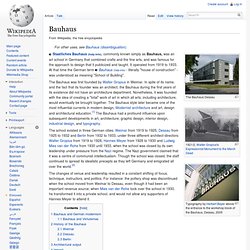
It operated from 1919 to 1933. At that time the German term Bauhaus - literally "house of construction" - was understood as meaning "School of Building". The Bauhaus was first founded by Walter Gropius in Weimar. The school existed in three German cities: Weimar from 1919 to 1925, Dessau from 1925 to 1932 and Berlin from 1932 to 1933, under three different architect-directors: Walter Gropius from 1919 to 1928, Hannes Meyer from 1928 to 1930 and Ludwig Mies van der Rohe from 1930 until 1933, when the school was closed by its own leadership under pressure from the Nazi regime.
Bauhaus and German modernism[edit] The Bauhaus Museum - Tel Aviv Bauhaus and Vkhutemas[edit] Modern architecture. Modern architecture or Modernist architecture is a term applied to an overarching movement, with its exact definition and scope varying widely.[1] The term is often applied to modernist movements at the turn of the 20th century, with efforts to reconcile the principles underlying architectural design with rapid technological advancement and the modernization of society.

It would take the form of numerous movements, schools of design, and architectural styles, some in tension with one another, and often equally defying such classification.[1] The term Modern architecture may be used to differentiate from Classical architecture following Vitruvian ideals, while it is also applied to various contemporary architecture styles such as Postmodern, High-tech or even New Classical, depending on the context. In art history, the revolutionary and neoclassical styles that evolved around 1800 are also called modern.
Characteristics[edit] Common themes of modern architecture include: Context[edit]