
Pikmin 2. Like its predecessor, Pikmin 2 focuses on exploring the surface of an unknown planet from a microscopic perspective, where the player directs and delegates tasks to a horde of tiny plant-like creatures called Pikmin.
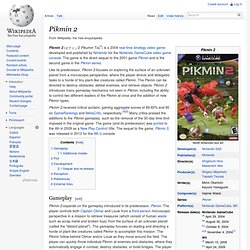
The Pikmin can be directed to destroy obstacles, defeat enemies, and retrieve objects. Pikmin 2 introduces many gameplay mechanics not seen in Pikmin, including the ability to control two different leaders of the Pikmin at once and the addition of new Pikmin types. Pikmin 2 received critical acclaim, gaining aggregate scores of 89.60% and 90 on GameRankings and MetaCritic, respectively.[4][5] Many critics praised the additions to the Pikmin gameplay, such as the removal of the 30-day time limit imposed in the original game. The game (and its predecessor) was ported to the Wii in 2009 as a New Play Control! Title. Donkey Kong Jungle Beat. Gameplay[edit] Gameplay involves combat, jumping, and counterattacking.

While the traditional GameCube controllers are compatible, Jungle Beat uses a pair of bongo drums to control Donkey Kong's (DK) actions. Hitting the left drum causes DK to move left, while hitting the right drum causes him to move right. Hitting both drums at the same time causes DK to jump. Clapping one's hands or hitting the sides of the drums also causes DK to clap, which has various consequences depending on the situation. This is a unique game in the nature of play; it is a platformer where the goal is not simply to get to the end of the level.
DK can perform moves such as backflips, the ground-pound, vine swinging, corner hopping, and wall jumping. Clapping or making any other noise that the microphone in the Bongos picks up makes DK clap his hands. The level system consists of several "kingdoms". Reception[edit] Non video-game publications also praised the GameCube version. Impact and legacy[edit] Chibi-Robo! Metroid Prime 2: Echoes. Retro decided to make the game different from its predecessor by adding more focus on storyline and including new gameplay elements.

Nintendo launched a viral marketing campaign to promote the game that included several websites written as if taking place in the Metroid universe. Echoes' single player mode and graphics were praised by critics, while its steep difficulty level and multiplayer components were met less positively. Since its release, Echoes has received several video game industry awards, as well as spots on "top games" lists by Nintendo Power and IGN. Over 800,000 copies of the game were sold worldwide. In 2009, an enhanced version was released for Wii as a standalone game in Japan and as part of Metroid Prime: Trilogy internationally. Gameplay[edit] Samus' head-up display shows a radar, map and remaining missile ammunition. Synopsis[edit] Setting[edit] Around this time, Space Pirates set up a base on Aether after detecting the mutagenic substance Phazon on the planet.
Metroid Prime. The game was a collaboration between Retro's staff in Austin, Texas and Japanese Nintendo employees, including producer Shigeru Miyamoto, who suggested the project after visiting Retro's headquarters in 2000.

Despite a backlash against the game's first-person perspective,[7] the game garnered universal acclaim and commercial success, selling more than a million units in North America alone.[8] It won a number of Game of the Year awards and is considered by many critics and gamers to be one of the greatest video games ever made and remains one of the highest-rated games on Metacritic.
In 2009, an enhanced version was released for Wii as a standalone game in Japan and as part of Metroid Prime: Trilogy internationally.[10] Gameplay[edit] Items[edit] While Samus is in Morph Ball form, the view changes to a third-person camera. Items from previous Metroid games appear with altered functions. Synopsis[edit] Background and setting[edit] Mario Power Tennis. Mario Power Tennis, known in Japan as Mario Tennis GC (マリオテニスGC, Mario Tenisu Jī Shī?)

, is a sports game developed by Camelot Software Planning and published by Nintendo for the GameCube in 2004.