
80 Million Tiny Images. You have submitted 0 labels.
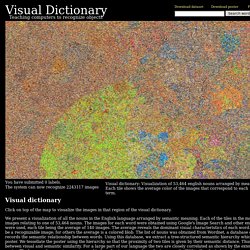
Visual dictionary: Visualization of 53,464 english nouns arranged by meaning. Each tile shows the average color of the images that correspond to each term. Visual dictionary Click on top of the map to visualize the images in that region of the visual dictionary. We present a visualization of all the nouns in the English language arranged by semantic meaning. Currently computers have difficult recognizing objects in images. Teaching computers to see When you visualize the images for each word, you can click on top of each image and select if they are correct examples of the associated word (a green frame will appear around the image) or if they are incorrect (a red cross will appear). Funding support came from NSF Career award (ISI 0747120), ISF and a Microsoft Research gift. Moths at Animal Corner. Moths Moth Description Moths often have feather like antennae with no club at the end.

When perched, their wings lay flat. Moths tend to have thick hairy bodies and more earth tone coloured wings. Moths are usually active at night and rest during the day in a preferred wooded habitat. Moths have very long proboscis, or tongues, which they use to suck nectar or other fluids. Not all Moths have long tongues. In some, there is no feeding mechanism at all. A moths antennae, palps, legs and many other parts of the body are studded with sense receptors that are used to smell. Moth Camouflage Camouflage is a great defence in avoiding detection by a hungry predator. Another effective form of camouflage is colouration which can confuse a predator into either striking at a none vital part of the moths body or into missing it all together. Another form of defence is where the moth takes on the appearance of a larger/or more threatening creature. Moth Vision. Project Gutenberg - free ebooks. How Little Do Users Read? Sense, Essence, and Existence - SEE Executive Summary.
Executive Summary In the history of attempts to understand consciousness there has been much debate over what is conscious, what is not, and what the relation is between the two categories. In simplistic terms, idealism conceives of matter as a phenomenon derived from consciousness while materialists conceive of consciousness as emerging from unconscious functions of matter. Dualism conceives of matter and consciousness as two fundamentally different categories of phenomena. Neutral Monism conceives of both mental and material phenomena as derived from a more fundamental property. Multisense Realism begins with the Neutral Monism view in which there is a meta-property from which all other discernments and relations are derived.
The first question that MR asks is, can we make sense of a universe which does not make sense already? Sensation links our awareness with our body with the outside world. Sense seems to have a lot to do with certain underlying themes. The Adventurous 500: Adventure, Entertainment & Everything Adventurous. What is the Ego, Anyway? “The world will ask you who you are, and if you do not know, the world will tell you.”

~Carl Jung Imagine just having been born. You don’t know anything. You’ve never experienced anything. But suddenly there is light, and chaos. There is so much happening. Among other things, you are seeing what you will later learn to call faces. You are hearing what you will later be told are voices. The one thing you are certainly not aware of, is you. How will you ever make sense of it all? Luckily, you are human (though you’re not aware of that yet) and human minds have the power of association. Associations like this accumulate. This is handy for sorting out the chaos around you.
You are still only looking outwards, and it has not yet occurred to you to inquire as to what is doing the looking. Over the first few years of your life, you will be taught that certain shapes and thoughts and sensations are you. They tell you the red book is yours, and the blue book is not yours. Biomimicry Institute - Home.