
Guiminer – An Extensive Tool For Bitcoin Mining. In order to successfully conduct Bitcoins mining, you’ll need a working “miner” that will make good use of your hardware (more about that later).
There are a handful of miners out on the Web, but many of them have a narrow window of hardware it can work with, or it is difficult to (easily) control because it only runs via a command line. No need to fear, though, because there’s a great program that comes with a GUI that does all the dirty work! What are Bitcoins About? Before we start, we need to understand a little better what Bitcoins are and what the mining process consists of.
Bitcoins are pieces of virtual money that can be traded around just like regular money, but with extremely low transaction fees (paid in Bitcoins). Their value changes based on demand, which can be tracked at Mt. More information about Bitcoin can be found in this well-written article. Starting guiminer Interface and Miners The interface is pretty simple. Whom to Mine For Extra AMD Graphics Card Settings Conclusion. Beginners Guide to Mining Bitcoins. Last updated on December 18th, 2017 at 06:06 pm One of the biggest problems I ran into when I was looking to start mining Bitcoin for investment and profit was most of the sites were written for the advanced user.

I am not a professional coder, I have no experience with Ubuntu, Linux and minimal experience with Mac. So, this is for the individual or group that wants to get started the easy way. 1. Category:Mining. Bitcoin Difficulty: 3,054,628.
Bitcoin Mining Update: Power Usage Costs Across the United States. Earlier this week we looked at Bitcoin mining performance across a large range of GPUs but we had many requests for estimates on the cost of the power to drive them.
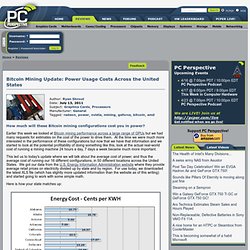
At the time we were much more interested in the performance of these configurations but now that we have that information and we started to look at the potential profitability of doing something like this, look at the actual real-world cost of running a mining machine 24 hours a day, 7 days a week became much more important. This led us to today's update where we will talk about the average cost of power, and thus the average cost of running our 16 different configurations, in 50 different locations across the United States. We got our data from the U.S. Energy Information Administration website where they provide average retail prices on electricity divided up by state and by region.
Here is how your state matches up: Group A: $0.15809 / kWhGroup B: $0.11606 / kWhGroup C: $0.09813 / kWhGroup D: $0.08246 / kWh Further Reading. Mining hardware comparison. See also: Non-specialized hardware comparison Below are statistics about the Bitcoin Mining performance of ASIC hardware and only includes specialized equipment that has been shipped. GPUs, CPUs and other hardware not specifically designed for Bitcoin mining can be found in the Non-specialized_hardware_comparison. Notes: Mhash/s = millions hashes per second (double sha256 raw speed performance; may not be very energy efficient with some models) Mhash/J = millions hashes per joule (energy efficiency; 1 joule of energy is 1 watt during 1 second: 1 J = 1 W*s) W = watt (maximum power consumption, i.e. energy per unit of time: 1 W = 1 J/s) Be sure to research any of these vendors and machines intensely before spending any money. ↑ Fpgaminer (May 19, 2011).
Pooled mining. Pooled mining is a mining approach where multiple generating clients contribute to the generation of a block, and then split the block reward according the contributed processing power.
Pooled mining effectively reduces the granularity of the block generation reward, spreading it out more smoothly over time. Introduction With increasing generation difficulty, mining with lower-performance devices can take a very long time before block generation, on average. For example, with a mining speed of 1000 Khps, at a difficulty of 14484 (which was in effect at the end of December, 2010), the average time to generate a block is almost 2 years. To provide a more smooth incentive to lower-performance miners, several pooled miners, using different approaches, have been created. Pooled mining approaches The problem with pooled mining is that steps must be taken to prevent cheating by the clients and the server. The slush approach The Pay-per-Share approach. GUI mining - updated Feb 19 with poclbm bugfix. Hey everyone, I've created a Windows GUI for mining Bitcoins using your GPU or CPU.
This is the easiest way to get started mining on Windows. No messing around with the command line is required, and it has several features beyond what command line miners provide. The GUI is free and open source, but if you successfully use this program to generate coins, I would appreciate a donation, no matter how small. How to Donate: Please send donations directly to: 1MDDh2h4cAZDafgc94mr9q95dhRYcJbNQo Most donations I receive are less than 0.1 BTC, so please consider donating even small amounts if this program helped you out. Features:- Comes already configured for many popular pools. . - Real-time statistics on all your running miners in one location.
. - Automatically start one or more miners on program startup. - View your account balance with a pool and/or withdraw funds from within the GUI, at participating pools. - Minimizes to tray. Mining.bitcoin.cz.