
Hex Grid Algorithm Testbed. This program illustrates the progress of an algorithm I developed to compute Field of View (FOV) within a hexagonal grid.

View is computed from the centre of a hexagon, and expands outward in discrete steps (by pressing the "Expand" button). The grid contains some obstacles (darkened hexagons) which block view through them. At each stage you see the set of "arcs" defining the current view radius. There are initially 4 arcs corresponding to the four quadrants; each arc is shown by drawing its two "arms" (and note that these are only drawn from the centre point out to where the defining point for the arm is, and not always out to the current perimeter of visibility), and (if you're viewing it in colour) shading the area between the arms and the centre in green. Visible hexes are shown by drawing a number in them (the centre hex is marked "C"). The complete source code is freely available in info-zip format. This code is by Clark Verbrugge. Hex Grid. Tactical affairs such as movement are best handled on a grid, but the grid need not be a bunch of squares.

This variant replaces the squares with hexagons. (Hex grid paper and mats are available at many hobby stores.) The primary advantage of this variant is that it eliminates the “every other square counts double” rule for diagonal movement, because it eliminates diagonal movement. Characters simply move from hex to adjacent hex, changing direction as they like. To determine the distance between two hexagons, just count hexes by the shorter path (in most cases, there will be a number of equally short paths). Using a hex-based grid changes relatively little about the game, but poses a mapping dilemma for the GM. Depending on their size, creatures take up one or more hexagons on the grid, as shown in the accompanying diagram. Spell areas change to accomodate the hex grid; refer to the diagram below. Hexagonal tiling. In geometry, the hexagonal tiling is a regular tiling of the Euclidean plane, in which three hexagons meet at each vertex.
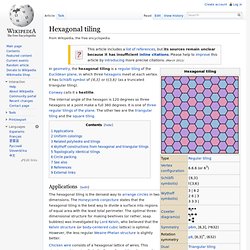
It has Schläfli symbol of {6,3} or t{3,6} (as a truncated triangular tiling). Conway calls it a hextille. The internal angle of the hexagon is 120 degrees so three hexagons at a point make a full 360 degrees. It is one of three regular tilings of the plane. The other two are the triangular tiling and the square tiling. Applications[edit] The hexagonal tiling is the densest way to arrange circles in two dimensions. Chicken wire consists of a hexagonal lattice of wires. The densest circle packing is arranged like the hexagons in this tiling. Hex map. A hex map, hex board or hex grid is a game board design commonly used in wargames of all scales.

The map is subdivided into small regular hexagons of identical size. Advantages and disadvantages[edit] The primary advantage of a hex map over a traditional square grid map is that the distance between the center of each hex cell (or hex) and the center of all six adjacent hexes is constant. By comparison, in a square grid map, the distance from the center of each square cell to the center of the four diagonal adjacent cells it shares a corner with is greater than the distance to the center of the four adjacent cells it shares an edge with.
The constant distance of a hex map is desirable for games in which the measurement of movement is a factor. One disadvantage of a hex map is that hexes have adjacent cells in only six directions instead of eight, as in a square grid map. Uses[edit] See also[edit] References[edit] External links[edit]