
Neuroplasticity: You Can Teach An Old Brain New Tricks. What's the Big Idea?

Your brain is more flexible than we've ever thought before. It changes because it is constantly optimizing itself, reorganizing itself by transferring cognitive abilities from one lobe to the other, particularly as you age. After a stroke, for instance, your brain can reorganize itself to move functions to undamaged areas. And yet, due to the lifestyles we lead we tend to not make full use of our brains. Dr. Learning Shelter. Mind power technique for danger. Short-term memory. Short-term memory (or "primary" or "active memory") is the capacity for holding a small amount of information in mind in an active, readily available state for a short period of time.

The duration of short-term memory (when rehearsal or active maintenance is prevented) is believed to be in the order of seconds. A commonly cited capacity is 7 ± 2 elements. In contrast, long-term memory can hold an indefinite amount of information. Short-term memory should be distinguished from working memory, which refers to structures and processes used for temporarily storing and manipulating information (see details below). Existence of a separate store[edit] The idea of the division of memory into short-term and long-term dates back to the 19th century. Not all researchers agree that short-term and long-term memory are separate systems. Further evidence against the existence of a short-term memory store comes from experiments involving continual distractor tasks. Ovid J.L. Biological basis[edit] Brain size and correlates with IQ « Race, genes, and disparity. When it comes to racial differences in intelligence, the average differences in cranial capacity are an important piece to the puzzle.

Whatever their ultimate cause (i.e. whether due to environmental differences or genetic differences that resulted from environmental differences), they establish the deep roots of general mental ability differences. In their recent discussion of race, genes, and IQ, Hunt and Carlson (2007) maintain that differential brain size is a reasonable line of investigation: Rushton (1995) maintained that one of the reasons for the White–African American disparity in IQ scores is that Whites have larger brain sizes than African Americans. Leaving aside the issue of whether or not one accepts this particular argument, the argument itself illustrates a useful principle. Le cerveau et les principales fonctions cognitives - HAPPYneuron. La mémoire est omniprésente dans la vie quotidienne.

Elle nous permet de retenir toute sorte d’informations (souvenirs personnels, connaissances culturelles, procédures automatiques…) pendant une durée plus ou moins longue (de quelques secondes à toute une vie). Elle constitue le passé de chacun, ou plutôt la connaissance de celui-ci, et permet ainsi à quiconque de posséder une identité. Plusieurs formes de mémoire : Nous ne possédons pas qu'une seule mémoire même si nous avons tendance à envisager la mémoire comme un tout en disant avoir, de façon globale, UNE bonne/mauvaise mémoire ou en utilisant des phrases du style : ''Je dois avoir LA mémoire qui flanche !
'' En effet, le souvenir de ce que l'on a mangé la veille est bien différent du souvenir que la capitale de la France est Paris. Prefrontal Cortex Controls Habits. Lee Rannals for redOrbit.com — Your Universe Online.

Functional brain network efficiency predicts ... [Hum Brain Mapp. 2012. Clustering coefficient. In graph theory, a clustering coefficient is a measure of the degree to which nodes in a graph tend to cluster together.
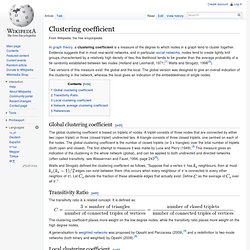
Evidence suggests that in most real-world networks, and in particular social networks, nodes tend to create tightly knit groups characterised by a relatively high density of ties; this likelihood tends to be greater than the average probability of a tie randomly established between two nodes (Holland and Leinhardt, 1971;[1] Watts and Strogatz, 1998[2]). Two versions of this measure exist: the global and the local. The global version was designed to give an overall indication of the clustering in the network, whereas the local gives an indication of the embeddedness of single nodes. Global clustering coefficient[edit] The race/intelligence/IQ debate. December 1997 Claims that "Blacks" are dumber than "Whites", a la The Bell Curve, crop up every so often on anthro-l.

Regular Exercisers Earn Nine Percent Higher Pay Than Those Who Don’t. Exercise: Fitter Kids Make Better Grades, Study Says. Yep.

Curls in the gym might give you accolades in school. That’s right, exercise may boost your grades. A recent study of more than 1200 middle school students in Texas noted that both boys and girls that had higher levels of heart and lung health had better scores and grades on both math and reading tests. After controlling for self-esteem and income status, researchers measured students’ levels of heart and lung health and body mass index. Regular Exercise Leads to a Healthier, Smarter Brain. Top 10 Ways to Make Yourself Look (and Be) Smarter. How terribly obnoxious of you.

Thanks for sharing. Well, it is probably not the smartest move ever to call monolingual people dumb. 13 Tips to Face Your Fear and Enjoy the Ride. Everyone is afraid.

I am, you are, everyone is! The only difference between you and the successful people you admire is that they are willing to work and move through their fears in order to get where they want to be. If you don’t learn how to face your fear it will grip your mind, body, and spirit.