
The Solar Project. Coordinates: Solar Two Power Tower Project The Solar Project consists of the Solar One, Solar Two and Solar Tres solar thermal power plants based in the Mojave Desert, USA and Andalucía, Spain. Solar Two was demolished in 2009.[1] Solar One[edit] Solar One was a pilot solar-thermal project built in the Mojave Desert just east of Barstow, CA, USA. Solar One's method of collecting energy was based on concentrating the sun's energy onto a common focal point to produce heat to run a steam turbine generator. Electricity from the sun and the wind. Now you must evaluate the reception that you got to your initial presentation of the concept.

You determine the scope of your initial project based on this reception. If it was overwhelmingly good, you could present a reasonable sized simple "by the book Earthship" as your project that you are requesting a permit for. If the reception was somewhat skeptical then you reduce the scope of what you are asking for. The point is to not ask for too much at first. Under the worst circumstances, you may only want to ask for a demonstration - permit for one room. What you are doing here is allowing an official the chance to see the concept before they are asked to risk their job on it. The point here is to determine just how small of a 'bite' to ask the inspector to swallow in this phase.
You present this demonstration as a rammed earth thermal mass dwelling - not a rubber tire house. Another factor of your presentation is not to mention all the other systems at first. We are here to help you! Solar Tree – Ross Lovegrove. Free power- How to convert a washing machine into a water powered generator. Clean, Free Energy. JAPANESE WATER POWERED CAR!! How to make a simple HHO (Hydrogen Gas) Generator...Run your car on water! Hydrogen. As the simplest atom known, the hydrogen atom has had considerable theoretical application.
For example, the hydrogen atom is the only neutral atom with an analytic solution to the Schrödinger equation. Hydrogen gas was first artificially produced in the early 16th century, via the mixing of metals with acids. In 1766–81, Henry Cavendish was the first to recognize that hydrogen gas was a discrete substance,[8] and that it produces water when burned, a property which later gave it its name: in Greek, hydrogen means "water-former".
Industrial production is mainly from the steam reforming of natural gas, and less often from more energy-intensive hydrogen production methods like the electrolysis of water.[9] Most hydrogen is employed near its production site, with the two largest uses being fossil fuel processing (e.g., hydrocracking) and ammonia production, mostly for the fertilizer market. Properties Combustion 2 H2(g) + O2(g) → 2 H2O(l) + 572 kJ (286 kJ/mol)[note 2] How Fuel Cells Work" You've probably heard about fuel cells.

In 2003, President Bush announced a program called the Hydrogen Fuel Initiative (HFI) during his State of the Union Address. This initiative, supported by legislation in the Energy Policy Act of 2005 (EPACT 2005) and the Advanced Energy Initiative of 2006, aims to develop hydrogen, fuel cell and infrastructure technologies to make fuel-cell vehicles practical and cost-effective by 2020. The United States has dedicated more than one billion dollars to fuel cell research and development so far.
So what exactly is a fuel cell, anyway? Why are governments, private businesses and academic institutions collaborating to develop and produce them? In this article, we'll take a quick look at each of the existing or emerging fuel-cell technologies. If you want to be technical about it, a fuel cell is an electrochemical energy conversion device. Fuel cell. Demonstration model of a direct-methanol fuel cell.
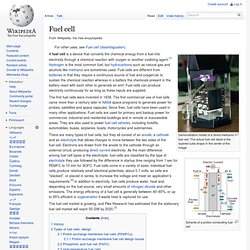
The actual fuel cell stack is the layered cube shape in the center of the image Scheme of a proton-conducting fuel cell The first fuel cells were invented in 1838. The first commercial use of fuel cells came more than a century later in NASA space programs to generate power for probes, satellites and space capsules. Since then, fuel cells have been used in many other applications. Could salt water fuel cars?" You may have heard about an invention created by a 63-year-old named John Kanzius that claims to create an alternative fuel out of salt water.
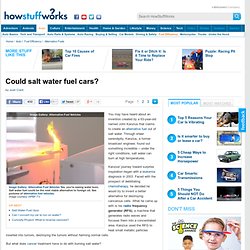
Through sheer serendipity, Kanzius, a former broadcast engineer, found out something incredible -- under the right conditions, salt water can burn at high temperatures. Kanzius' journey toward surprise inspiration began with a leukemia diagnosis in 2003. Faced with the prospect of debilitating chemotherapy, he decided he would try to invent a better alternative for destroying cancerous cells. What he came up with is his radio frequency generator (RFG), a machine that generates radio waves and focuses them into a concentrated area. Kanzius used the RFG to heat small metallic particles inserted into tumors, destroying the tumors without harming normal cells.
But what does cancer treatment have to do with burning salt water? Elenco OWI Salt Water Fuel Cell Car:Amazon:Toys & Games. Japanese breakthrough will make wind power cheaper than nuclear. NOTE: Some major wind projects like the proposed TWE Carbon Valley project in Wyoming are already pricing in significantly lower than coal power -- $80 per MWh for wind versus $90 per MWh for coal -- and that is without government subsidies using today's wind turbine technology.

The International Clean Energy Analysis (ICEA) gateway estimates that the U.S. possesses 2.2 million km2 of high wind potential (Class 3-7 winds) — about 850,000 square miles of land that could yield high levels of wind energy. This makes the U.S. something of a Saudi Arabia for wind energy, ranked third in the world for total wind energy potential. The United States uses about 26.6 billion MWh's, so at the above rate we could satisfy a full one-third of our total annual energy needs. Now what if a breakthrough came along that potentially tripled the energy output of those turbines? You see where I'm going. Well, such a breakthrough has been made, and it's called the "wind lens. " Editor's note: Want more info?