
La livre sterling ou le secret de la baisse du chômage en Angleterre. FIGAROVOX/ANALYSE - L'économiste dresse le bilan économique de David Cameron.

Il souligne l'efficacité de la politique monétaire de la Banque d'Angleterre, mais regrette que le Premier ministre ait cédé au «dogme de l'austérité budgétaire». Charles Wyplosz est professeur d'économie internationale à l'Institut de hautes études internationales et du développement (IHEID) à Genève, et directeur du Centre international d'études monétaires et bancaires.
Ses principaux domaines de recherche sont les crises financières, l'intégration monétaire européenne, les politiques monétaires et budgétaires ainsi que l'intégration monétaire régionale. The Mitrokhin archive: KGB defector's copied files reveal Soviet dismay at ‘constantly drunk’ Guy Burgess. Among thousands of typed Russian documents in the Mitrokhin archive, open to public inspection for the first time this week, they describe how Burgess, who was “constantly drunk”, horrified his KGB controllers by staggering out of a pub one evening and dropping stolen Foreign Office documents on the pavement.
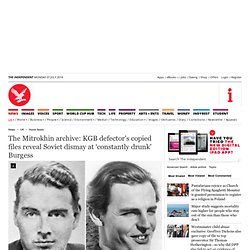
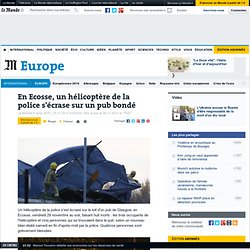
Moscow was also kept informed about Donald Maclean’s alcoholic binges and loose tongue. It emerges that the spy they valued most was the remarkable Melita Norwood, nicknamed “The Spy Who Came in From the Co-op”, who died in 2005 aged 93. She was never prosecuted and would never have been exposed but for the archive of Vasili Mitrokhin, a senior officer in the Soviet political police who brought the documents to Britain after he defected. En Ecosse, un hélicoptère de la police s'écrase sur un pub bondé. Un hélicoptère de la police s'est écrasé sur le toit d'un pub de Glasgow, en Ecosse, vendredi 29 novembre au soir, faisant huit morts : les trois occupants de l'hélicoptère et cinq personnes qui se trouvaient dans le pub, selon un nouveau bilan établi samedi en fin d'après-midi par la police.
NE QUITTEZ PAS – Agacé par le télémarketing, un Britannique décide de faire payer les entreprises. DERNIÈRE CHANCE – Une petite cuillère dans la culotte contre les mariages forcés. En Grande-Bretagne, plusieurs jeunes filles qui devaient être mariées de force à l'étranger ont réussi à échapper à leur funeste sort en cachant une cuillère dans leurs sous-vêtements, rapporte le Guardian.
L'idée vient d'une organisation de soutien aux victimes de mariages forcés, Karma Nirvana, qui explique que cette cuillère ainsi dissimulée fera sonner le portique de détection des métaux.
UK nuclear arsenal. UK Defense cuts. UK funds poll in Pakistan on US drone attacks. Britain has been forced to admit that it has been funding surveys in Pakistan's Federally Administered Tribal Areas that reveal US drone strikes in the region are causing deep resentment among the local population.
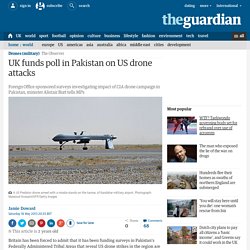
In an answer to a parliamentary question, the foreign minister, Alistair Burt, confirmed that the Foreign Office had "supported" surveys which showed the proportion of respondents in the tribal areas who believed drone strikes were "never justified" had risen from 59% in 2010 to 63% in 2011. It appears to be the first time that the government has revealed it has carried out opinion polls on the CIA drone campaign in Pakistan – a programme on which it has refused to comment publicly. Previously British ministers have said: "Drone strikes are a matter for the United States and Pakistan. " Nuclear test veterans win war pensions after four year battle with Ministry of Defence - Mirror Online - Pale Moon. Survivors of Britain's nuclear tests have won war pensions after a four-year fight with the Ministry of Defence.
A judge ruled this week that men ordered into the fallout zone were injured by radiation in the 1950s and 60s. The ruling is the first time UK nuke vets have been awarded money in recognition of their illnesses. They say radiation left them with cancers, rare illnesses and birth defects in their children. It opens the door for remaining veterans, now thought to number less than 3,000, to finally claim against the government that ordered them into danger. Ex-Prime Minister Baroness Thatcher dies, aged 87. 8 April 2013Last updated at 15:57 ET Baroness Thatcher was the first woman to be UK prime minister, winning three elections Former Prime Minister Baroness Thatcher has died "peacefully" at the age of 87 after suffering a stroke while staying at the Ritz hotel in central London.
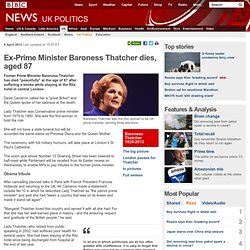
David Cameron called her a "great Briton" and the Queen spoke of her sadness at the death. Lady Thatcher was Conservative prime minister from 1979 to 1990. She was the first woman to hold the role. Nuclear essential for UK energy future, chief adviser says. As Britain published its nuclear energy strategy paper on March 26, the governmentâs chief science adviser said a nuclear-free future was not an option for the UK.
Nuclear power is essential for Britainâs energy future, said science adviser John Beddington, the Guardian reports. UK ready for Syria evacuation. Are we? A report emerged this week (thanks Sam) that the UK is gearing up for a possible mass evacuation of British citizens from Syria , with a helicopter carrier and amphibious assault ship to be deployed to the Eastern Mediterranean for exercises after the Olympic Games finish. The exercise has evidently been planned for some time and isn't a direct response to events in Syria, but according to the UK Telegraph, the flotilla could be used to evacuate British citizens from the Middle East if needed. The French will join the exercise too, with an aircraft carrier, escort ships and a strike force of Rafale fighters. UK to continue aid to India, terminates aid to 16 other nations.
London, Feb.28: Britain will continue providing financial aid to India, but will cut off aid to sixteen other nations, following a review, that proves they are no longer in the poverty bracket.
Following an inquiry ordered by International Development Secretary Andrew Mitchell, countries such as Russia, China, Vietnam, Cambodia, Moldova and Serbia will not be provided financial aid by UK, the Daily Mail reports. The UK however, has decided to continue providing 280 million pounds to India. The overall aid budget is likely to increase by four billion pounds over the next four years. Nearly 30 percent of the increased budget will be given to countries like Yemen and Somalia, to help them fight terrorism. Britain and the Asia-Pacific: no comment. Monty Python - Pythonline.com. David Miliband. A Fistful of Euros. Tweets after soldier’s death lands some in jail. Matthew Yglesias » Sympathy for Gordon Brown.