
Paul Ricœur. Un article de Wikipédia, l'encyclopédie libre.
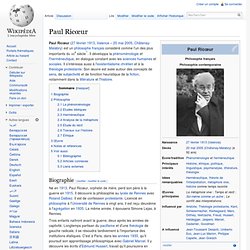
Paul Ricœur Philosophe français Philosophie contemporaine Biographie[modifier | modifier le code] Né en 1913, Paul Ricœur, orphelin de mère, perd son père à la guerre en 1915. Trois enfants naîtront avant la guerre, deux après les années de captivité. Les années 1980 consacrent le retour de Paul Ricœur au premier plan de la vie intellectuelle française. Soi-même comme un autre (1990) propose des variations sur le sujet sensible, parlant et agissant. Philosophie[modifier | modifier le code] La phénoménologie[modifier | modifier le code] Sa thèse de doctorat (1950) sur la Philosophie de la volonté est nettement imprégnée de pensée phénoménologique.
La phénoménologie n'est cependant pas l'horizon complet de la méthodologie de Ricœur. Pourtant, cette ontologie, comme en témoigne la conférence que Ricœur prononça devant ses maîtres L'unité du volontaire et de l'involontaire comme idée limite, reste une marge, un résidu, de la phénoménologie. Ricoeur Paul. Bibliographies Paul Ricoeur (Bibliographies d'auteurs protestants, Service documentation de la Fédération protestante de France)Raynova, Yvanka B.

Brève bibliographie primaire et secondaire (Site académique Paul Ricoeur)Oeuvres de Ricoeur (adpf, 2005)Bibliographie (Fondation internationale Balzan)Paul Ricoeur, brève sélection de livres autour de son oeuvre (Librairie l'Arrêt aux pages)Petite bibliographie commentée proposée par Le Figaro Livres Karl Jaspers et la philosophie de l’existence. En collaboration avec Mikel Dufrenne. Gabriel Marcel et Karl Jaspers: Philosophie du mystère et philosophie du paradoxe, Paris, Temps présent, 1948. Philosophie de la volonté (1950-1960)tome 1: Le volontaire et l'involontaire, Paris, Aubier, 1950; réédité en 1988. Platon et Aristote. De l'interprétation. Le conflit des interprétations. La métaphore vive, Paris, Seuil, coll. Interpretation Theory : Discourse and the Surplus of Meaning. Temps et récit (1983-1985)Tome I. Du texte à l'action. Paul Ricoeur. First published Mon Nov 11, 2002; substantive revision Mon Apr 18, 2011 Paul Ricoeur (1913–2005) is widely recognized as one of the most distinguished philosophers of the twentieth century.

In the course of his long career he wrote on a broad range of issues. His books include a multi-volume project on the philosophy of the will: Freedom and Nature: The Voluntary and the Involuntary (1950, Eng. tr. 1966), Fallible Man (1960, Eng. tr. 1967), and The Symbolism of Evil (1960, Eng. tr. 1970); a major study of Freud: Freud and Philosophy: An Essay on Interpretation (1965, Eng. tr. 1970); The Rule of Metaphor (1975, Eng. tr. 1977); Interpretation Theory: Discourse and the Surplus of Meaning (1976); the three-volume Time and Narrative (1983-85, Eng. tr. 1984–88); Lectures on Ideology and Utopia (1986); the published version of his Gifford lectures: Oneself as Another (1990, Eng. tr. 1992); Memory, History, Forgetting (2000, Eng. tr. 2004); and The Course of Recognition (2004, Eng. tr. 2005).