
The unfinished art business of World War Two. 4 November 2013Last updated at 14:36 ET By Godfrey Barker Art market expert and journalist Manet's Wintergarden - stolen by the Nazis - was found by US troops in 1945, hidden in a salt mine The astonishing find in a Munich flat of 1,500 paintings missing since 1939 points to two art crimes.

The first is Adolf Hitler's crusade to fill his Fuehrermuseum at Linz, Austria, with the supreme paintings of the world - looted, confiscated and purchased by the Nazis in the occupied countries of France, the Netherlands, Belgium, Austria, Czechoslovakia, Poland and Russia. The second is the crime of covering up the truth ever since. Cornelius Gurlitt, 80, whose hoard of paintings in Munich was allegedly hidden behind a wall of ancient cans of food, has kept his secrets for 68 years. What they tell us about Hitler is more important than what they reveal about Gurlitt. Propagandist Joseph Goebbels in a radio broadcast called Germany's degenerate artists "garbage". Shady business Gurlitt was no small buyer. Health - Does listening to Mozart really boost your brainpower? It is said that classical music could make children more intelligent, but when you look at the scientific evidence, the picture is more mixed.
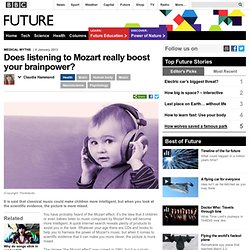
You have probably heard of the Mozart effect. It’s the idea that if children or even babies listen to music composed by Mozart they will become more intelligent. A quick internet search reveals plenty of products to assist you in the task. Whatever your age there are CDs and books to help you to harness the power of Mozart’s music, but when it comes to scientific evidence that it can make you more clever, the picture is more mixed.
The phrase “the Mozart effect” was coined in 1991, but it is a study described two years later in the journal Nature that sparked real media and public interest about the idea that listening to classical music somehow improves the brain. I’ll leave the debate on the impact on milk yield to farmers, but what about the evidence that listening to Mozart makes people more intelligent? Brain arousal.
Whitney Houston and the art of melisma. 15 February 2012Last updated at 10:29 By Lauren Everitt BBC News Magazine Whitney Houston will be remembered as a master of "melisma".

But what is it and why did it influence a generation of singers and talent show aspirants? An early "I" in Whitney Houston's I Will Always Love You takes nearly six seconds to sing. In those seconds the former gospel singer-turned-pop star packs a series of different notes into the single syllable. The technique is repeated throughout the song, most pronouncedly on every "I" and "you". The vocal technique is called melisma, and it has inspired a host of imitators. It can be heard in the songs of Beyonce, Christina Aguilera, Jennifer Hudson and others. Continue reading the main story “Start Quote You can't do it without proper breath control, and that's the one thing that Whitney Houston had bags of” End QuoteSarah-Jane DaleOpera singer But the melisma craze isn't limited to contestants. But most fail - miserably, according to Waterman. Stars who have used melisma. In pictures: Science meets art in annual contest.
Last Judgment (detail 2) 1306, Fresco, Cappella Scrovegni (Arena Chapel), Padua - Reproduction - www.giottodibondone.org - Large. Music.