
WaterWars. The next major conflict in the Middle EastWater Wars A Lecture by Adel Darwish- Geneva conference on Environment and Quality of Life June 1994.
Oil has always been thought of as the traditional cause of conflict in the Middle East past and present. Since the first Gulf oil well gushed in Bahrain in 1932, countries have squabbled over borders in the hope that ownership of a patch of desert or a sand bank might give them access to new riches. No longer. Now, most borders have been set, oil fields mapped and reserves accurately estimated - unlike the water resources, which are still often unknown. When President Anwar Sadat signed the peace treaty with Israel in 1979, he said Egypt will never go to war again, except to protect its water resources. All these nations depend on three great river systems, or vast underground aquifers, some of which are of `fossil water' that cannot be renewed.
Take the greatest source of water in the region, the Nile. The shortage: Country 1955 1990 2025. Water Shortage, Drinking Water Crisis Solutions. Water ... worth more than gold and more crucial for survival above all other resources on earth.
And yet, over one billion men, women, and children do not have enough safe water to drink and therefore will never live a healthy life. Who are these people? They are the innocent children and desperate families living in overcrowded urban slums, in refugee camps, and in poverty-stricken towns and villages too numerous to count in rural areas of developing countries around the world. Here, less than 50% of the population has access to safe drinking water and only 25% have access to sanitary systems.
These rural villagers have no political power, have no visibility and have no voice in the discussion of the human right to water. The Problem Global Water is based upon the belief that the lack of access to safe drinking water is the primary cause of hunger, disease and poverty throughout the developing world. Hunger Without water, crops and livestock wither and die. Disease Poverty The Solution. HDR06-complete. Water crisis. "In Meatu district, Shinyanga region, Tanzania, water most often comes from open holes dug in the sand of dry riverbeds, and it is invariably contaminated.
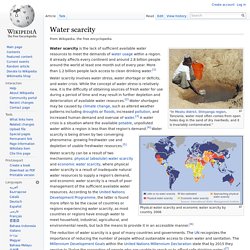
" Physical water scarcity and economic water scarcity by country. 2006 Water scarcity is the lack of sufficient available water resources to meet the demands of water usage within a region. It already affects every continent and around 2.8 billion people around the world at least one month out of every year. More than 1.2 billion people lack access to clean drinking water.[1] Water scarcity involves water stress, water shortage or deficits, and water crisis. Water scarcity can be a result of two mechanisms: physical (absolute) water scarcity and economic water scarcity, where physical water scarcity is a result of inadequate natural water resources to supply a region's demand, and economic water scarcity is a result of poor management of the sufficient available water resources.
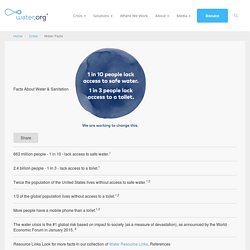
Water stress[edit] Changes in Climate[edit] Facts: Water. Water 1 in 10 people lack access to safe water Sanitation 1 in 3 people lack access to a toilet Women & Children Women and children spend 125 million hours each day collecting water Disease Every 90 seconds a child dies from a water-related disease Economics Every $1 invested in water and sanitation provides a $4 economic return Facts About Water & Sanitation Share 663 million people - 1 in 10 - lack access to safe water.1 2.4 billion people - 1 in 3 - lack access to a toilet.1 Twice the population of the United States lives without access to safe water.1,2 1/3 of the global population lives without access to a toilet.1,2 More people have a mobile phone than a toilet.1,3 The water crisis is the #1 global risk based on impact to society (as a measure of devastation), as announced by the World Economic Forum in January 2015. 4 Resource Links Look for more facts in our collection of Water Resource Links.
References Donate now Get involved chevron_right Enewsletter sign-up.