
This Designer Has Carved a Spoon Every Day For a Year. Underwater Photographer of the Year 2015 winners – in pictures. The world's most beautiful metro stations - in pictures. 15 Hilariously Bad Designs for Everyday Objects. "That's right, Francine.
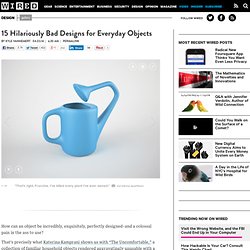
I've killed every plant I've ever owned. " Katerina Kamprani "Yes, I'm thrilled you wanted to come up for a night cap. Le graffiti, ce n’est pas défier le système mais l’assimiler. La semaine dernière, C215 publiait une tribune sur l’art urbain sur Rue89.
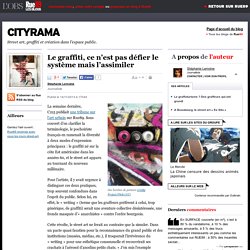
Sous couvert d’en clarifier la terminologie, le pochoiriste français en ramenait la diversité à deux modes d’expression principaux : le graffiti né sur la côte Est américaine dans les années 60, et le street art apparu au tournant du nouveau millénaire. Pour l’artiste, il y avait urgence à distinguer ces deux pratiques, trop souvent confondues dans l’esprit du public. Selon lui, en effet, le « writing » (terme que les graffeurs préfèrent à celui, trop générique, de graffiti) serait une aventure collective désintéressée, une fronde masquée d’« anarchistes » contre l’ordre bourgeois.
Art Everywhere turns UK's streets into world's largest art show. How Olympic cauldron fanned flames of fury at American design studio. As the polished copper petals of Thomas Heatherwick's Olympic cauldron rose up to form a striking flaming dandelion last July, gasps of awe and wonder echoed around the world at the structure's startling originality.
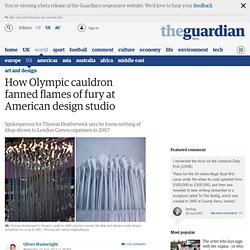
In the offices of the New York design studio Atopia, however, there were gasps of a different kind. "We were absolutely furious," said the practice's co-director Jane Harrison. "It looked identical to something we had proposed to the London Olympic committee back in 2007, after which we hadn't heard anything. " Locog originally approached Atopia, whose motto is "anticipate the future", to come up with ideas for a One Planet pavilion, a structure to embody the sustainable ethos behind the London Games. "Our pitch was all about the story," Harrison said. Les Impressionnistes et la Normandie : un tableau, une photo - Arts et scènes.
Funny foreigners: how overseas comics are storming Edinburgh. Ancient temple complex discovered near Le Mans. Excavations near the antique city of Vindunum (now Le Mans) have revealed a vast religious site dating from the first to the third centuries AD with remarkably well-preserved offerings.
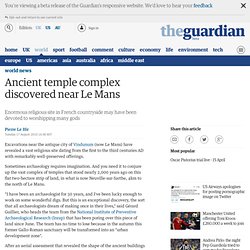
Sometimes archaeology requires imagination. And you need it to conjure up the vast complex of temples that stood nearly 2,000 years ago on this flat two-hectare strip of land, in what is now Neuville-sur-Sarthe, 4km to the north of Le Mans. Top 25 des plus belles oeuvres sur bouche d’égout » Article. Une bouche d'égout, quoi de plus laid ?
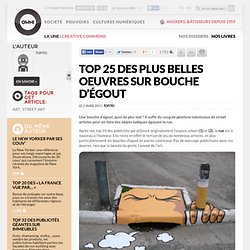
Il suffit du coup de peinture talentueux de street artistes pour en faire des objets ludiques égayant la rue. Après nos top 10 des publicités qui utilisent originalement l’espace urbain (1) et (2), la rue est à nouveau à l’honneur. Elle reste en effet le terrain de jeu de nombreux artistes, et plus particulièrement les bouches d’égout et autres caniveaux. Hidden treasures revealed (British Museum) Olympic legacy murals met with outrage by London street artists. Glaring out from the brick wall of an old sweet factory on the edge of the Olympic site in east London, a furious face throws a toothy snarl across the canal.
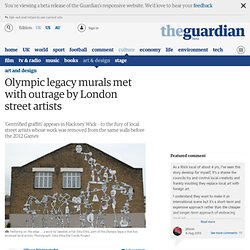
Half monkey, half skull, with a golden clothes peg for a nose, the creature has every reason to be angry. It is the work of local street art collective, the Burning Candy Crew, whose psychedelic scenes defined this industrial stretch of the River Lea Navigation, until they were mostly painted over in preparation for the 2012 Games. Now, on those very walls, the Olympic legacy's public art body has unveiled a series of new artworks – with not a local artist in sight. “It was a very deliberate decision,” says Sarah Weir, former head of arts and cultural strategy for the Olympics, who now heads up the Legacy List charity that commissioned the work. “We unashamedly wanted to showcase the best international artists and transform this part of the canal into a destination for street art.
WTF: 1890s Lavatory Reimagined As A Chic Cafe. In what's easily the most creative (and nuttier) adaptive re-use project we've seen, The Attendant in London converts a Victorian-era public lavatory into a posh new cafe.
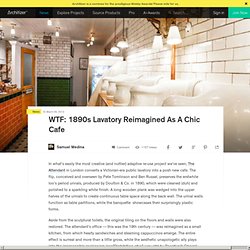
The flip, conceived and overseen by Pete Tomlinson and Ben Russel, preserves the erstwhile loo's period urinals, produced by Doulton & Co. in 1890, which were cleaned (duh) and polished to a sparkling white finish. A long wooden plank was wedged into the upper halves of the urinals to create continuous table space along the back wall. The urinal walls function as table partitions, while the banquette showcases their surprisingly plastic forms. Aside from the sculptural toilets, the original tiling on the floors and walls were also restored. Bits of buildings: How is computing changing the architect’s job? In 1957, when local officials in Sydney, Australia, were judging entries in a competition to design their new opera house, they settled on an unusual plan by a Danish architect, Jorn Utzon.

Yolanda dominguez : Poses. Radev collection: tale of three art lovers to be told in new touring exhibition. One was a Bulgarian stowaway who became the love of an English literary giant; the second was a gentleman art dealer who once had an affair with the opium-addicted Jean Cocteau; and the third was an aristocratic music critic who inherited one of Britain's largest houses. Together they created a remarkable art collection about to be seen in public for the first time.
The Radev collection, containing works by artists including Amedeo Modigliani, Graham Sutherland and Alfred Wallis, can from this weekend be viewed online. A week later, selected works will go on display at the Pallant House gallery in Chichester before touring to Lincoln, Bath, Falmouth and Kendal. Sculpting shapes that don't exist. Kat Austen, CultureLab editor (Image: Tony Cragg, 2007, private collection.
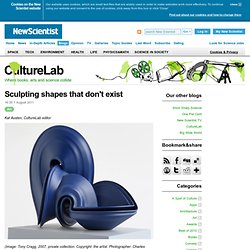
Copyright: the artist. Photographer: Charles Duprat) 'This is freedom' – visual art and the Egyptian uprising. Art may not have started the Egyptian revolution, but it played a large part once the spark was lit.
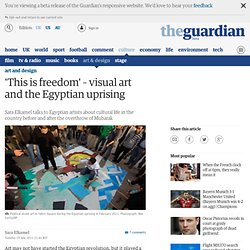
Visual artists documented the people's uprising, first in Tahrir Square, and then across galleries in Cairo and Egypt in the months that followed. The young multimedia artist Ahmed Bassiouny was killed on the third day of the revolution; his work was shown posthumously at this year's Venice Biennale. Today, the art scene remains in a state of flux, experiencing a kind of chaotic freedom as demonstrators return to Tahrir Square. During the Mubarak era of pseudo-democracy, many artists camouflaged their opposition behind symbolic colours and shapes. In the years leading up to the revolution, 58-year-old painter Mohamed Abla focused on social and environmental issues, his canvases crowded with thousands of dots – a comment on Egypt's burgeoning population.
Other artists are currently transforming the landscape. Kenneth Grange: A very British modernist. Somewhere in the backslapping fest that was the final issue of the News of the World, there were the stirrings of something worth reading. Under the headline "Cream of Britain", the article revealed what MPs had chosen as the greatest designs from their constituencies. These included the custard cream, the fish finger and McCain Smiley Potato Faces. Not to belittle the cultural impact of anthropomorphised potato powder, but MPs should probably head down to the Design Museum.
Sir George Gilbert Scott, the unsung hero of British architecture. Pollock: Artist and physicist? © President and Fellows of Harvard College A Harvard mathematician examines the science behind artist Jackson Pollock's work. Pollock and his paintings in a 1950 photograph by Harvey A. Weber. Reproduced with permission from the Harvard Art Museums/Fogg Museum Imaging Department. De l'encre. Now Be Yourself ///. Light - Portfolio - Main - solovyovdesign. Energy Efficient Bulb. Fly poo never looked so beautiful…
Time Warp - Water Balloon to the Face. Escher's impossible waterfall as Rube Goldberg device. Google takes art lovers on a virtual grand tour. Alternative / Spoken Word / Science. Gallery - Natural beauty: Wellcome Image Awards gallery - Image 1 - New Scientist. Human landscapes in SW Florida. The Miss Van Pool. New spirit grips the arts inspired by funding cuts. In pictures: Urban beauty. Grandma's Superhero Therapy (18 photos) Cannon Hill Park, December 2010 : un album. Why aren't there more roles like Séraphine for British women? Chris Jordan - In Katrina's Wake. This series, photographed in New Orleans in November and December of 2005, portrays the cost of Hurricane Katrina on a personal scale.
Chris Jordan - Intolerable Beauty. Chris Jordan - Midway. Photo Manipulations by Erik Johansson. Murakami-Exhibition-Launc-022.jpg (JPEG Image, 719×480 pixels) David Shrigley saves the arts from cuts – and wants you to help.