
Critical thinking web. Critical thinking web. How should critical thinking be taught?

There are lots of different issues to be investigated, such as: Should critical thinking be taught as a separate subject on its own, or should it be taught in combination with other specific subjects that the students are studying? Which are the topics that are most crucial? How to Teach Critical Thinking. Robert H.

Ennis, rhennis@illinois.edu The actual teaching of critical thinking is a function of many situation-specific factors: teacher style, teacher interest, teacher knowledge and understanding, class size, cultural and community backgrounds and expectations, student expectations and backgrounds, colleagues’ expectations, recent local events, the amount of time available to teachers after they have done all the other things they have to do, and teacher grasp of critical thinking, to name some major factors. I here suggest some general strategies and tactics gleaned from years of experience, research, and others’ suggestions. They are guidelines and must be adjusted to fit the actual situation. Ten Takeaway Tips for Teaching Critical Thinking. Suggestions from educators at KIPP King Collegiate High School on how to help develop and assess critical-thinking skills in your students.
Ideally, teaching kids how to think critically becomes an integral part of your approach, no matter what subject you teach. But if you're just getting started, here are some concrete ways you can begin leveraging your students' critical-thinking skills in the classroom and beyond. 1. Questions, questions, questions. Questioning is at the heart of critical thinking, so you want to create an environment where intellectual curiosity is fostered and questions are encouraged. In the beginning stages, you may be doing most of the asking to show your students the types of questions that will lead to higher-level thinking and understanding. 2. Pose a provocative question to build an argument around and help your students break it down. Case Study: Culture at KIPP King Collegiate.
Jason Singer: Culture at this school is not something that adults steward for kids.

Culture at King is something kids do for all of us. Kate Belden is our assistant principal of student support. She facilitates culture in this building. And Kate's in charge of everything that leverages the critical thinking that our kids have developed, and focuses them on our virtues as kind of a filter. Kate Belden: So the four virtues that we focus on here at our school are wisdom, justice, courage and humanity. Gabriela: My name is Gabriela Ballesteros. Kate Belden: So Gabi came to us from a traditional middle school, so a non Kipp middle school. Gabriela: It was horrible. Kate Belden: In the ninth grade year, really struggled academically. Gabriela: When I first came here, it was totally different. Kate Belden: And this year has been, you know, really-- doing really well. Gabriela: -- the idea of 'Pay It Forward' is more powerful than him, because even when he chose to take on his-- Training Teachers to Teach Critical Thinking. How KIPP educators instruct their colleagues to enhance their classroom practice.
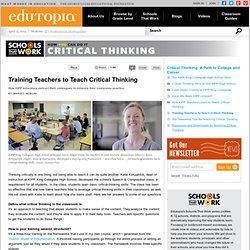
KIPP King Collegiate High School principal Jason Singer trains his teachers to lead Socratic discussions (above); Katie Kirkpatrick (right), dean of instruction, developed a step-by-step framework -- described below -- for teaching students basic critical-thinking skills. Credit: Zachary Fink Thinking critically is one thing, but being able to teach it can be quite another. Katie Kirkpatrick, dean of instruction at KIPP King Collegiate High School, developed the school's Speech & Composition class, a requirement for all students. In the class, students learn basic critical-thinking skills. Define what critical thinking in the classroom is. It's an approach to teaching that allows students to make sense of the content. How is your training session structured? It's a three-hour training on the frameworks that I use in my own course, which I generated from the Toulmin Model of Argumentation.
How to Check for Deeper Understanding and Engage All Students. Consider the following two scenarios, though fictitious. Two different teachers teaching the same learning objectives using checking for deeper understanding as their main method and strategy. Classroom X: Understanding Gone Wrong "What do plants eat? " Some students raise their hands, most just look at their teacher. The teacher then asks one of the boys frantically waving his hand in the front of the room.
"They eat dirt! " "Well, that is not precisely the right answer. Why and How to Teach Critical Thinking – Tool Kits. If you believe in conspiracy theories, enjoy posting political links, or are an apologist for alternative medicine, you probably don’t want to be my Facebook friend.

You see, I have a rather outspoken inner skeptic that feels compelled to fact-check anything that sounds outlandish or unlikely. I try to squelch it from time to time, for the sake of politeness and decorum, but it’s a relentless voice with nagging questions.