Blaise Pascal. "Man is but a reed, the most feeble thing in nature, but he is a thinking reed.

The entire universe need not arm itself to crush him. A vapor, a drop of water suffices to kill him. But, if the universe were to crush him, man would still be more noble than that which killed him, because he knows that he dies and the advantage which the universe has over him, the universe knows nothing of this. All our dignity then, consists in thought. By it we must elevate ourselves, and not by space and time which we cannot fill. --Pascal Pensees 347 Pascal was a child prodigy, who was educated by his father. In 1646 Pascal learned of Toricelli's experiments with the barometer and the theory of air preassure.
Pascal became involved with a religious movement in France know as Jansenism after its founder Cornelis Jansen (1585-1636) in 1646 when Pascal's father had an accident and was cared for by Jansenists. Pascal Time Line Pascal Time Line Sources Bibliography. Ada Lovelace: Founder of Scientific Computing. Born: London, England, December 10, 1815 Died: London, England, November 27, 1852 Ada Byron was the daughter of a brief marriage between the Romantic poet Lord Byron and Anne Isabelle Milbanke, who separated from Byron just a month after Ada was born.
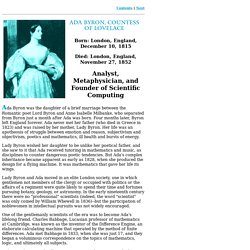
Four months later, Byron left England forever. Ada never met her father (who died in Greece in 1823) and was raised by her mother, Lady Byron. Her life was an apotheosis of struggle between emotion and reason, subjectivism and objectivism, poetics and mathematics, ill health and bursts of energy. Lady Byron wished her daughter to be unlike her poetical father, and she saw to it that Ada received tutoring in mathematics and music, as disciplines to counter dangerous poetic tendencies. Lady Byron and Ada moved in an elite London society, one in which gentlemen not members of the clergy or occupied with politics or the affairs of a regiment were quite likely to spend their time and fortunes pursuing botany, geology, or astronomy. TED: Ideas worth spreading. George Dyson at the birth of the computer. Hubbert's Peak, The Peak. World oil production will start to fall sometime during this decade, never to rise again.

In 1956, M. King Hubbert predicted that U.S. oil production would peak in the early 1970's. Although Hubbert was widely criticized by some oil experts and economists, in 1971 Hubbert's prediction came true. The 100 year period when most of the world's oil is being discovered became known as "Hubbert's Peak". The peak stands in contrast to the hundreds of millions of years the oil deposits took to form. Hubbert's methods predict a peak in world oil production less than five years away. Ordinarily, we look to new technology for solutions to problems. There are long-term solutions to our future energy problems: conservation and both fossil and renewable energy sources. Alfred Wegener. "Scientists still do not appear to understand sufficiently that all earth sciences must contribute evidence toward unveiling the state of our planet in earlier times, and that the truth of the matter can only be reached by combing all this evidence. . .

It is only by combing the information furnished by all the earth sciences that we can hope to determine 'truth' here, that is to say, to find the picture that sets out all the known facts in the best arrangement and that therefore has the highest degree of probability. Further, we have to be prepared always for the possibility that each new discovery, no matter what science furnishes it, may modify the conclusions we draw. " Alfred Wegener. The Origins of Continents and Oceans (4th edition) Some truly revolutionary scientific theories may take years or decades to win general acceptance among scientists.
Born on November 1, 1880, Alfred Lothar Wegener earned a Ph.D in astronomy from the University of Berlin in 1904. Sir Isaac Newton: The Universal Law of Gravitation. Sir Isaac Newton: The Universal Law of Gravitation There is a popular story that Newton was sitting under an apple tree, an apple fell on his head, and he suddenly thought of the Universal Law of Gravitation.

As in all such legends, this is almost certainly not true in its details, but the story contains elements of what actually happened. What Really Happened with the Apple? Probably the more correct version of the story is that Newton, upon observing an apple fall from a tree, began to think along the following lines: The apple is accelerated, since its velocity changes from zero as it is hanging on the tree and moves toward the ground.
Thus, by Newton's 2nd Law there must be a force that acts on the apple to cause this acceleration. Sir Isaac's Most Excellent Idea. Darwin Awards. Homo sapiens sapiens decline, Neo Sapiens rise. April 2012.