
Philosophie de la programmation. “Première raison.
The “Unhyped” New Areas in Internet and Mobile. Editor’s note: Legendary investor Vinod Khosla is the founder of Khosla Ventures.
You can follow him on Twitter at @vkhosla. All Khosla Ventures investments, as well as ventures related to Vinod Khosla, are italicized. We are in a whole new world of platforms, a post-PC era, which I’d more aptly describe as the always/everywhere era, finally, and that means a whole new set of opportunities. Add to it the fact that because of a variety of factors too numerous to cover here, the cost of experimentation has gone down dramatically (one can start a web startup or write an Android app with no more than a student credit card!) Questions numériques 2012-2013, le temps des ruptures (2/2) : le point de vue des entrepreneurs et créateurs.
Si la première table ronde de la journée Questions numériques a réuni essentiellement des acteurs collectifs, la seconde a vu se succéder des représentants du monde de l’entreprise, du design et de la création artistique.

Vers une « grosse fatigue » numérique ? Isabelle Bordry, présidente du WebMediaGroup, spécialisé dans le commerce électronique, a choisi le scénario sur la grosse fatigue numérique, en précisant toutefois qu’elle avait plutôt l’intention d’aller contre cette hypothèse. Questions numériques 2012-2013, le temps des ruptures (1/2) : Secessions territoriales. Aggregation, Not Algorithms, Is The Key To Establishing Trust Online. The biggest issue the new sharing economy is currently facing is one of trust.

After issues like the Airbnb debacle and high-end car sharing service HiGear’s closure due to theft, it's clear that trust issues are the main barrier preventing sharing from becoming mainstream. The answer that everyone seems to be looking for is a some sort of global reputation system. John Palfrey » Blog Archive » Intellectual Property Strategy: Book Launch.
I’m excited to be launching a new book, Intellectual Property Strategy, tonight at Harvard Law School.

(If you’re in Cambridge, MA, USA, please feel free to come by Austin Hall East at HLS at 6:00 pm this evening for the event and a reception thereafter or tune into the webcast.) The discussion tonight will cover two bases: first, the substance of the book and second, the format of this book, and possibly others, into the future. On the substance of this book, I will make a few claims. The basic claim is extremely simple: organizations should see intellectual property as a core asset class rather than as a sword and a shield, as the traditional mantra would have it. I argue also that IP strategies should be flexible; geared toward creating freedom of action; and inclined toward openness where possible, at least in the information technology field.
. - The smartphone OS wars are the most obvious example of how IP matters. . - The use of IP in libraries and museums is a third important case. Digital Content Is Different. Yesterday we sat down with someone who is starting a new digital venture.

As we discussed the potential, the market, the options and much more, it became apparent to us that there are a lot of things that applied to the physical book market, that simply do not apply, or should be questioned in the digital market. Walking blindly into the digital world assuming that all remains the same is in danger of establishing a set of urban myths that we have written about in the past but that continue to dog all our thinking and real digital opportunities.
We would like to take the opportunity to offer a dozen points as to why we believe digital content is different. 1. Size - 256 pages and x thousand words were mere economic parameters that prevailed and mattered in the physical world. Casser la page. Peter Meyers d'O'Reilly Media s'est lancé dans l'écriture d'un livre, Breaking the Page (Casser la page), où, en ligne, billet après billet, il pose des questions percutantes sur la conception de nos livres numériques.

Son propos est d'interroger ce qu'on peut faire avec le livre numérique et qu'on ne peut pas faire avec le livre imprimé. Comprendre et analyser les différences, en designer, pour imaginer des supports et logiciels de lecture mieux adaptés à nos pratiques. Rien de moins. Dans un billet introductif intitulé "Je ne sais pas", il a eu l'humilité de reconnaître que ceux qui travaillent à l'avant-garde de la transition de l'imprimé à l'écran, n'ont souvent aucune idée de ce qu'ils font. Le simple fait de reconnaître que l'on ne sait pas est parfois la meilleure façon de comprendre où nous devons tourner notre attention. L'arc narratif s'est transformé "La forme dominante du livre imprimé est linéaire. Or rien de tout cela n'est désormais nécessaire. Amazon.com : l'Empire caché.
Www.sogeti.com/upload/Employees only/Collaboration in the Cloud/Book - Collaboration in the Cloud - OK.pdf. The Web Is Dead. Long Live the Internet. Two decades after its birth, the World Wide Web is in decline, as simpler, sleeker services — think apps — are less about the searching and more about the getting.
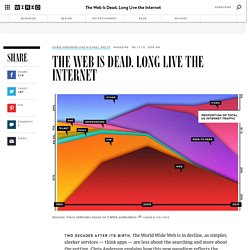
Chris Anderson explains how this new paradigm reflects the inevitable course of capitalism. And Michael Wolff explains why the new breed of media titan is forsaking the Web for more promising (and profitable) pastures. We're sharing things on the web, but what is the web sharing with us? Sharing on the web is something that we all do.

Be it sharing a link on Twitter or Recommending something on Facebook, it’s something we do everyday. This is great for our friends and family, as they are seeing content that they probably wouldn’t have stumbled onto themselves. But I’m going to ask the question that nobody seems to be asking. What’s in it for us?