
Japanese breakthrough will make wind power cheaper than nuclear. NOTE: Some major wind projects like the proposed TWE Carbon Valley project in Wyoming are already pricing in significantly lower than coal power -- $80 per MWh for wind versus $90 per MWh for coal -- and that is without government subsidies using today's wind turbine technology.

The International Clean Energy Analysis (ICEA) gateway estimates that the U.S. possesses 2.2 million km2 of high wind potential (Class 3-7 winds) — about 850,000 square miles of land that could yield high levels of wind energy. This makes the U.S. something of a Saudi Arabia for wind energy, ranked third in the world for total wind energy potential. The United States uses about 26.6 billion MWh's, so at the above rate we could satisfy a full one-third of our total annual energy needs.
Welcome to my DIY website for re. Back to main site Welcome to my DIY website for renewable energy enthusiasts.

The purpose of this site is to share my experiences of designing and making renewable energy projects for very little money. It is a resource for DIY enthusiasts and for educational purposes, to ultimately share thoughts and ideas via the forum. Stepper motor. The stepper motor generator This size 34 -14 v stepper motor was bought on eBay for £25.
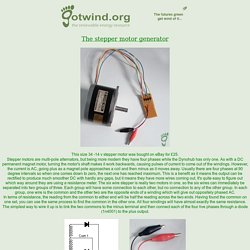
Stepper motors are multi-pole alternators, but being more modern they have four phases while the Dynohub has only one. As with a DC permanent magnet motor, turning the motor's shaft makes it work backwards, causing pulses of current to come out of the windings. However, the current is AC, going plus as a magnet pole approaches a coil and then minus as it moves away.
Usually there are four phases at 90 degree intervals so when one comes down to zero, the next one has reached maximum. The simplest way to wire it up is to link the two commons to the minus terminal and then connect each of the four live phases through a diode (1n4001) to the plus output. Cycle_computer. Wireless cycle computer as an RPM monitor Along with the usual amperage and voltage measurements usually associated with wind generators to monitor it's performance, another useful measurement you can make is the RPM of your turbines blades.
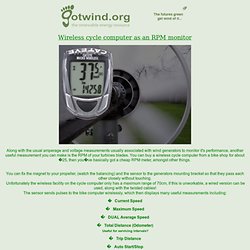
You can buy a wireless cycle computer from a bike shop for about 25, then youve basically got a cheap RPM meter, amongst other things. You can fix the magnet to your propeller, (watch the balancing) and the sensor to the generators mounting bracket so that they pass each other closely without touching. Unfortunately the wireless facility on the cycle computer only has a maximum range of 70cm, if this is unworkable, a wired version can be used, along with the twisted cables! Wind Power Maps - State Maps. Wind Turbine Concepts Defined and Explained. On this page we attempt to give a brief introduction to the basic concepts of designing and building wind turbines. | Site | Tower | Anemometers | Generators & Alternators | Cut-In Speed | Alternator Design || Rotor Design & Carving | Furling & Shutdown | Regulation | Slip Rings | Futher Reading | Where do you start???
First, do your homework! Why re-invent the wheel when you can learn from others' successes and failures? There are many useful books, websites and plans available. First, figure out how big a wind generator you are willing to tackle, either commercial or home-brewed. Site Location--First, figure out the direction from which the prevailing winds in your area usually come. Seabell International - "Wing" wind speed adjusting composite vertical axis wind turbine. Wind Turbine Design – The Most Amazing Windmills in the World. A journey through the evolution of the most spectacular wind turbines designs in the world - Looking for an environmentally friendly energy source while looking gracious, aesthetic and beautiful?

The answer is blowing in the wind! Wind turbines float in the air, some rotate horizontally, others vertically. Small Wind Turbine Farm Nearly Complete at Quinnipiac University. Adobe’s installation of 20 small wind turbines on the sixth floor of their headquarters building made big news recently.
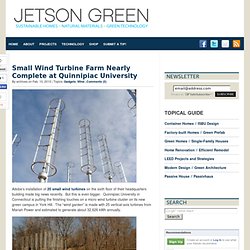
But this is even bigger. Quinnipiac University in Connecticut is putting the finishing touches on a micro wind turbine cluster on its new green campus in York Hill. The “wind garden” is made with 25 vertical-axis turbines from Mariah Power and estimated to generate about 32,626 kWh annually. It’s not a lot, but it’s enough to power half of the external site lights for the 250-acre campus. Installation began in September of last year and, pending grid connection and landscaping, a flip of the switch is coming soon.
This is likely the first cluster of its kind to be installed on an American college campus. Jeff Riley, FAIA, Centerbrook partner in charge of the project, recently said, “Wind power is one of a number of green technologies and approaches incorporated into the site design.” Wind Farms Of Small Vertical Axis Turbines More Efficient, Cheaper Than Conventional Projects. Photo: John Dabiri/Caltech An interesting new study in the Journal of Renewable and Sustainable Energy turns on its head conventional wisdom about both the optimum technical solution and spacing for wind power projects so that they generate the most electricity.Researchers from the California Institute of Technology found that large horizontal axis wind turbines, broadly spaced (as in what you likely think of in a commercial wind farm) are far bettered by using shorter, vertical axis turbines, tightly spaced.
VAWTs are ideal, [John] Dabiri says, because they can be positioned very close to one another. This lets them capture nearly all of the energy of the blowing wind and even wind energy above the farm. In tests, VAWTs generate 21-47 watts of power be square meter of land area of the project, compared 2-3 watts for the HAWTs. Fish hold the key to better wind farms. According to Robert W.
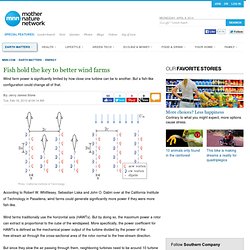
Whittlesey, Sebastian Liska and John O. Urban windmills harm the environment. "The problem is not the windmill - it is the wind" Small windmills have been around for some decades, but in recent years the focus has shifted on developing their potential use in an urban environment (where most of us live).
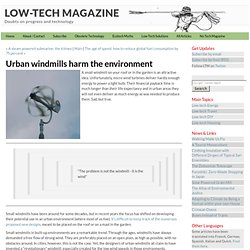
It’s difficult to keep track of the numerous proposed new designs, meant to be placed on the roof or on a mast in the garden. MICRO WIND TURBINES: Small Size, Big Impact. Making a simple Savonius wind turbine. By Lance Turner There are many situations where you might need a small amount of electricity, for instance running gate openers, safety lights, water level indicators and other low-power devices.
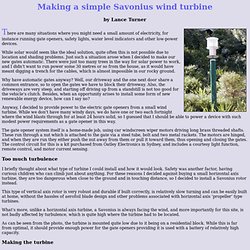
While solar would seem like the ideal solution, quite often this is not possible due to location and shading problems. Just such a situation arose when I decided to make our new gates automatic. There were just too many trees in the way for solar power to work, and I didn’t want to run power some 30 metres or so from the house, as it would have meant digging a trench for the cables, which is almost impossible in our rocky ground. Why have automatic gates anyway? Anyway, I decided to provide power to the electric gate openers from a small wind turbine. The gate opener system itself is a home-made job, using car windscreen wiper motors driving long brass threaded shafts. Too much turbulence. Build your own Savonius VAWT (Vertical Axis Wind Turbine) Savonius Wind Turbines. What is a savonius wind turbine - savonius (VAWT) home > wind | education A Savonius is a type of vertical axis wind turbine (VAWT) generator invented in 1922 by Sigurd Johannes Savonius from Finland though similar wind turbine designs had been attempted in previous centuries.
The Savonius is a drag-type VAWT which operates in the same way as a cup anemometer (pictured below). Looking at the anemometer, it has three cups mounted on a rotor which is free to spin. Helix Wind. How to Make an Inexpensive Vertical Wind Turbine - Part 1. Bluenergy AG Worldwide. Involute Wind Turbine. Home-Built Windpower. Updated January 2007 hugh@scoraigwind.co.uk This page is designed to help those who plan to build their own wind turbine. I hope you find it useful. Home Page. An educational 3 phase turbine kit. How I built an electricity producing wind turbine. Several years ago I bought some remote property in Arizona.
I am an astronomer and wanted a place to practice my hobby far away from the sky-wrecking light pollution found near cities of any real size. I found a great piece of property. The problem is, it's so remote that there is no electric service available. Homemade solar, wind and green power diy projects to generate en. PVC blades are an excellent, quick, light, cheap and very easy. So how do you make them? Do-It-Yourself (DIY) Wind Turbine. Vela Creations - Chispito How to. Forcefield - Otherpower - Wondermagnet Online Store. By Dan Bartmann and Dan Fink Foreword by Mick Sagrillo 320 pages, soft cover, 8 x 10 inches, 395 illustrations ISBN 978-0-9819201-0-8 Published by Buckville Publications LLC, Masonville, CO Retail price: US $39.95. Windmill Power.