
Edge-Plus™ Buildingscience. The SystemThe classic and time-proven strawbale wall assembly consists of strawbales laid flat with a 1 to 1.5 inches (25 to 38 mm) thick metal mesh reinforced cement and/or lime stucco skin applied directly to each face.
Earth plasters, usually somewhat thicker, have also been widely used. It behaves in most respects like a sandwich panel system, e.g., Structural Insulated Panel Systems (skins of OSB glued to foam plastic cores), reinforced cement skins glued to a polystyrene core, etc. The reinforced skins take almost all of the load since these are the stiffest and strongest materials in the system. The strawbales act as a substrate for the stucco and as effective insulation.
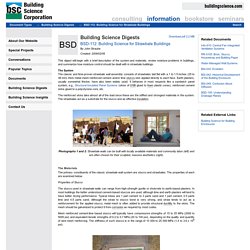
Photographs 1 and 2: Strawbale walls can be built with locally available materials and community labor (left) and are often chosen for their sculpted, massive aesthetics (right). The Materials The primary constituents of the classic strawbale wall system are stucco and strawbales. Properties of Stucco Wetting Drying. Advanced Wall Framing. RS_2010-03_Exterior_Insulation. Insulation Materials. Insulation materials run the gamut from bulky fiber materials such as fiberglass, rock and slag wool, cellulose, and natural fibers to rigid foam boards to sleek foils.
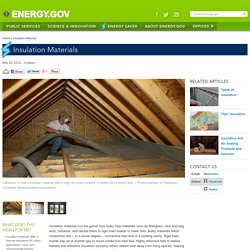
Bulky materials resist conductive and -- to a lesser degree -- convective heat flow in a building cavity. Rigid foam boards trap air or another gas to resist conductive heat flow. Highly reflective foils in radiant barriers and reflective insulation systems reflect radiant heat away from living spaces, making them particularly useful in cooling climates. Other less common materials such as cementitious and phenolic foams and vermiculite and perlite are also available. Fiberglass Fiberglass (or fiber glass) -- which consists of extremely fine glass fibers -- is one of the most ubiquitous insulation materials. Manufacturers now produce medium- and high-density fiberglass batt insulation products that have slightly higher R-values than the standard batts. Mineral Wool Insulation Materials Cellulose Insulation Material Cotton.
Straw Bale Design- Choosing the Right Size Straw Bales. By Chris Keefe Well the first question is what kind of bales: two or three stringers?

There are many ways to answer this question, and just like the rest of the straw bale design field, you have to see what you have in front of you. How much space can be afforded to the bale wall? What kinds of bales are available to your client locally? Is the climate hot, moderate or cold? These questions could be answered separately but the plain fact is that they must all be addressed as a whole before proceeding at least past the schematic design phase.
If you are designing a smaller building, the two stringers may be the better choice to allow for more interior floor space. Finding the bales locally will probably save money in delivery costs for the client, and will help support a local farmer. Back to the Drawing Board The window sill height should correspond with the dimensions of the bale heights. For the top plate height, again it would be smart to base it on the bale’s height. A Final Thought. Straw Bale. Is Double-Stud Wall Construction the Path to Efficiency on a Budget? Writing from Glacier, Washington, Karen Bean faces a home-building dilemma that confronts many thousands of people: what's the best way to insulate the walls of her new house on a modest budget?

She has $150,000 to spend on the two-bedroom, two-bathroom house, which she plans to build on a foundation originally intended for a traditional house. Although the concrete-block foundation is well made, it's not necessarily well matched to the double 2x4 walls she's hoping to use. "Is double wall with blown fiberglass insulation worth the extra cost? " she asks in her Q&A post. "And can it be done on an already laid concrete block foundation? Bean's quandary is the subject of this week's Q&A Spotlight. Suggestions for a truss wall system Bean helps clear up some confusion over exactly what climate zone Glacier is in; it turns out that the site is relatively cold. Rob Harrison is using a similar approach on a cabin not far away, in Wauconda, WA. His walls will include 15-in. CIMA-TechnicalBulletin02.