
Armour: No PR nightmare that the NFL can't make worse. Boycott Rolling Stone Magazine for their latest cover. Divine Rhetoric: God In The Inaugural Address : It's All Politics. Pizza Hut stunt gets the wrong kind of buzz. Perhaps you've seen that Visa commercial in which a little girl asks Ray Lewis questions during a press conference like, "Toast or home fries?
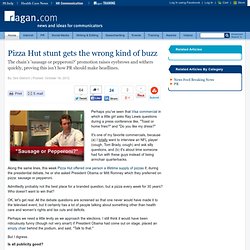
" and "Do you like my dress? " It's one of my favorite commercials, because (a) I totally want to interview an NFL player (cough, Tom Brady, cough) and ask silly questions, and (b) it's about time someone had fun with these guys instead of being armchair quarterbacks. Along the same lines, this week Pizza Hut offered one person a lifetime supply of pizzas if, during the presidential debate, he or she asked President Obama or Mitt Romney which they preferred on pizza: sausage or pepperoni. How SuperPACs Are 'Gaming' The 2012 Campaign. Hide captionJoe Hagan's cover story in the Jan. 22 edition of New York Magazine details why the 2012 election will be the "most negative in the history of American politics.
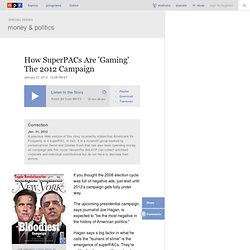
" New York Magazine Joe Hagan's cover story in the Jan. 22 edition of New York Magazine details why the 2012 election will be the "most negative in the history of American politics. " If you thought the 2008 election cycle was full of negative ads, just wait until 2012's campaign gets fully under way. The upcoming presidential campaign, says journalist Joe Hagan, is expected to "be the most negative in the history of American politics. " New Book Announcement: Social Media and Public Relations: Eight New Practices for the PR Professional. Professor Kirk Hazlett shares advice for PR students and professionals - National Public Relations. Associate Professor of Communication at Curry College, Kirk Hazlett, APR, Fellow PRSA, shares how he prepares his students for the real-life practice of public relations and offers suggestions for professionals who seek continued education in the field.
News flash: Journalists don't make better PR pros. A post that ran last week on Ragan.com ("What makes a good PR pro: A degree or a journalism background?
") How SEO Can Work With Content Strategy. Recently I spoke with Content Strategist, Margot Bloomstein, who was conducting research for an upcoming publication about Content Strategy intended for a variety of audiences.

In particular, we discussed productive interactions and exchanges between Search Engine Optimization professionals and Content Strategists. Organizations advance their reach and engagement goals through content and Strategists work to audit, develop strategy, plan, create and maintain that content. Basic HTML Skills Every PR Professional Should Have « PR at Sunrise.
Posted by: Evan Walsh at October 17th, 2015 in Interior Always inspect the availability of space when doing many improvements.

The Ethics of Whisper Campaigns. By: Gini Dietrich | May 16, 2011 | “For years, Mark Zuckerberg, the chief executive of Facebook, has extolled the virtue of transparency, and he built Facebook accordingly.
Defining the Social Customer. PR Industry Fills Vacuum Left by Shrinking Newsrooms. Can PR and Social Media Really Convert Sales? We’ve all had discussions about the benefits of social media marketing; what it can do for brand awareness, for word of mouth and brand perception, and for driving traffic to websites via direct routes, referrals and through search engines. Facebook May Hire Robert Gibbs, Former Obama Aide.
Facebook is in talks to hire Robert Gibbs, President Obama’s former White House press secretary, for a senior role in helping to manage the company’s communications, people briefed on the negotiations said.
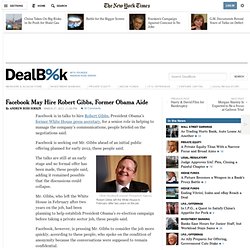
Facebook is seeking out Mr. Gibbs ahead of an initial public offering planned for early 2012, these people said. Did Chrysler overreact to accidental f-bomb tweet? Fresh Ideas. Empowered. By Josh Bernoff This is the second of three posts analyzing the contents of my inbox.
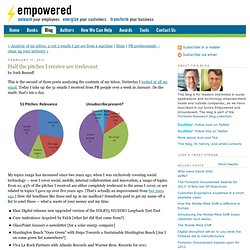
Yesterday I looked at all my email. Today I take up the 51 emails I received from PR people over a week in January. Do the math: that's ten a day. The Problem With Public Relations. Moving Past Twitter’s Gate-Keepers « Adam P. Coulter: Conduit for Young Communicators. More and more it seems that Twitter is becoming an integral part of/player in the news of the world.
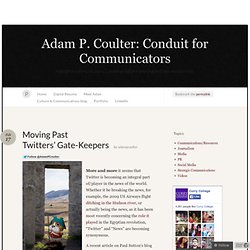
Whether it be breaking the news, for example, the 2009 US Airways flight ditching in the Hudson river, or actually being the news, as it has been most recently concerning the role it played in the Egyptian revolution, “Twitter” and “News” are becoming synonymous. A recent article on Paul Sutton’s blog The Social Web, and the report by HP found below, got me thinking about the topic of media gatekeepers, Twitter, news and how digital marketers can engage with Twitter to make it (news) and get results.
First, Paul’s piece asks some great questions concerning PR and the fact that Twitter now is the news and breaks it many times even before the mainstream media sites do. He writes, “As for PR, our job used to be to provide newspapers, magazines and broadcast media with stories; facts and comments about client projects that managed or created reputation and demand. Photo credit: Joshin Yamada. Main. Coca-Cola transforms ‘Happiness Machine’ into a truck. Hoping viral lightning will strike twice, Coke adds mobility and international venues; Facebook fans could help determine where it shows up next.
By Matt Wilson | Posted: February 25, 2011 Untitled Document You’ve probably seen a video depicting college students getting free Coca-Cola, pizzas, a huge submarine sandwich, flowers and more from a Coke vending machine in a university lobby in the past year. Since its January 2010 launch, the original “Happiness Machine” video has garnered more than 3.2 million views. The big Quora question: What’s it good for? Social Media Leadership Series - Kevin King. Best Buy parlays its tech expertise into a video network. The Future Of PR When Every Company Is Now A Media Company... - Posted by Tom Foremski - April 24, 2009. Public Relations for 2011- Small Bites.
Kenneth Cole’s Twitter blunder shows why participation matters. In case this tweet from @KennethCole is later deleted, I took the above screenshot. This is the next tweet the account made. That next tweet missed two key words: We apologize. Social Media Strategy & PR 2.0: If Twitter Breaks the News, Where Does That Leave PR?