
Chart a New Course: Put Design Thinking to Work. If you just ran the d.gift crash course, we hope you and your team found it to be a valuable experience, and you’re excited about doing more design thinking.
If so, you are likely asking yourself how to maintain the momentum and integrate a design approach into your work. Well, guess what? (Three actually. We stayed up all night!) Each is a different way to advance your project — think of them as a soundtrack for your next journey! Choose one of them to help you immediately bring design thinking into your real-life challenges. In the spirit of bias-toward-action, get started now while you’ve still got your dancing shoes on. Start here: Think about a challenge you and your team are facing. UNDERSTAND mixtape: Discovering insights via human engagementEXPERIMENT mixtape: Advancing your solution via prototypingIDEATE mixtape: Generating unexpected ideas via reframing your challenge. Ordering the Heavens: A Visual History of Mapping the Universe. By Maria Popova From Copernicus to Ancient Korea, or what the Chinese concept of change has to do with Aztec astrology.
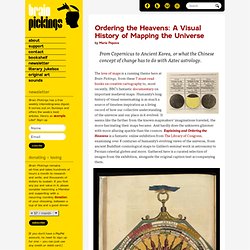
The love of maps is a running theme here at Brain Pickings, from these 7 must-read books on creative cartography to, most recently, BBC’s fantastic documentary on important medieval maps. Humanity’s long history of visual sensemaking is as much a source of timeless inspiration as a living record of how our collective understanding of the universe and our place in it evolved. It seems like the farther from the known mapmakers’ imaginations traveled, the more fascinating their maps became. And hardly does the unknown glimmer with more alluring sparkle than the cosmos. Here’s A Google Perk Any Company Can Imitate: Employee-To-Employee Learning. Adam Green sprinkles his lecture on data visualization with class participation.

“Does anyone read sheet music?” He asks before showing a video that re-imagines music notation in a more visual way. “Anyone ever in the military?” He asks before explaining that branch of government’s preference for white type on black backgrounds. History of Earth in 24-hour clock. How To Capture Ideas Visually With The iPad. By its very design, the iPad promotes consumption.
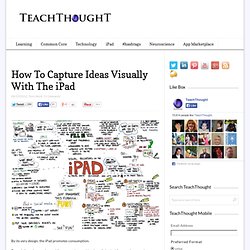
Essentially an interactive mobile screen, the combination of physical form and supporting software-based user interface on Apple’s wunder-tablet suggests watching and listening, enabling you to tear the “monitor” off the desk and take it with you. By lacking a keyboard, input and production aren’t quite as natural. That isn’t necessarily because the iPad can’t accommodate such input, but rather that the software–and our habits as users–haven’t completely caught up with the not-insignificant shift in interface.
But it doesn’t have to be that way. One microcosm of the potential of the iPad in learning is the concept of visual recording.
Look - See - Imagine - Show: The Visual Thinking Process. Goalscape Review. Over 100 Incredible Infographic Tools and Resources (Categorized) This post is #6 in DailyTekk’s famous Top 100 series which explores the best startups, gadgets, apps, websites and services in a given category.

Total items listed: 112. Time to compile: 8+ hours. Follow @DailyTekk on Twitter to make sure you don’t miss a week! VISUAL NOTE-TAKING by Austin Kleon. [ Watch a high-quality HD version on Vimeo ] I was invited to draw TEDxAustin this weekend.
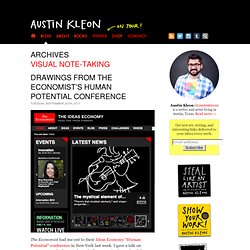
I was skeptical about an event that was so secretive about its contents beforehand, but it far exceeded my expectations. It was well-planned, well-executed, and had a stellar lineup of speakers. I bumped into lots of great people and had some good conversations. Kudos to the team, and thanks to my buddy Sunni Brown for the invite! The theme of the day was “Play Big,” so I decided to do something special: I drew the background stage and the studio in my sketchbook, then drew the speakers on sticky notes. Favorites? If written notes are your thing, John Lebkowsky has some great ones. Uajourn.pbworks.com/f/How To Steal Like An Artist (And 9 Other Things Nobody Told Me) - Austin Kleon.pdf. Posts tagged "steal like an artist"
If I remember correctly, my editor and I were on the phone talking about format ideas and trim sizes for Steal Like An Artist, and the problem was that my slides for the original talk were landscape format but books are usually portrait format.

So I think Bruce suggested meeting in the middle and making it square. So I went hunting for square books, and it turned out that James Kochalka’s The Cute Manifesto, one of my favorite little square books, is in the exact trim size we were talking about using, 6x6. So I drew up a cover, printed it out, and wrapped it around my copy to make a dummy book: I took that up to Workman and left it with them, and the story goes that they mocked up a bunch of other covers and laid them all out, but the late Peter Workman pointed to my dummy book and said, “That one.”
Anatomy of a Mindmap.