
European Travel Compact Camera 2011-2012 - Casio EXILIM EX-ZR100. Optomechanical Components. Lenses for SLR and DSLR cameras. A collection of lenses a DSLR owner might have.
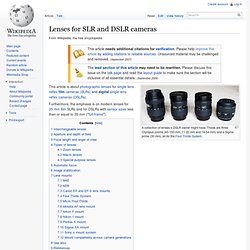
These are three Olympus zooms (40-150 mm, 11-22 mm and 14-54 mm) and a Sigma prime (30 mm), all for the Four Thirds System. This article is about photographic lenses for single-lens reflex film cameras (SLRs) and digital single-lens reflex cameras (DSLRs). Furthermore, the emphasis is on modern lenses for 35 mm film SLRs and for DSLRs with sensor sizes less than or equal to 35 mm ("full-frame"). Interchangeable lenses[edit] Most SLR and DSLR cameras provide the option of changing the lens.
As implied by the above, lenses are only directly interchangeable within the "mount system" for which they are built. Aperture and depth of field[edit] The Olympus E-System. Lenses for Olympus E-System Cameras. High Image Quality. One way to express the performance of a lens is the MTF (Modulation Transfer Function) curve, which represents the degree to which a lens is capable of faithful reproduction of lines with a width of 1 mm (spatial frequency response).
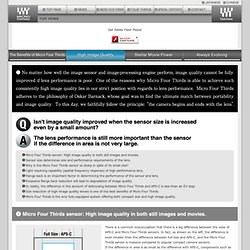
MTF is measured based on the contrasts of the lowest and highest frequencies emitted from the subject in order to estimate the resolution and clearness of the lens. The diagram below is the MTF graph of the ZUIKO DIGITAL ED 150mm (equivalent to 300mm on a 35mm film camera), a highly rated high-performance compact super-telescopic lens. The MTF graph shows that the resolved spatial frequencies (both the low- and high-ends) are high and that both high clarity and high resolution are balanced at a high level. Products(Camera Bodies)
Panasonic : DMC-GH2 The Creative HD Hybrid Digital Camera with Touch-Control, featuringFull HD Movie Recording and the World's Fastest Level of Light Speed AF * Thanks to the newly developed 16.05-megapixel multi-aspect Live MOS Sensor and the new Venus Engine FHD, Lumix GH2 brings superb picture quality for both still and moving images.

Both high resolution and excellent S/N are realized with more than 3dB noise reduction and double sensitivity. Infrared Photography with a Digital Camera. Fogging Certain cameras or lenses may exhibit some fogging, or image areas with extra exposure (for example, a bright central spot seen with many Canon lenses).

This may be due to light scattered from inner surfaces of the lens, or to some peculiarities of anti-reflective lens coating which was not really designed for infrared. Sometimes the blackness of internal surfaces of the lens tube or mirror chamber may be "not black enough" in infrared. (I experienced the last effect a few years ago with an Olympus E-10, where the extreme 15% or so of many frames was ghosted.)
The Future of Nikon FX and DX. The Future of FX and DX Formats © 2008 KenRockwell.com.
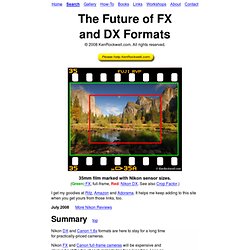
All rights reserved. 35mm film marked with Nikon sensor sizes. Macro Lenses from Nikon. Macro photography is one of the most interesting types of photography, as it lets you show detail that is otherwise not easily seen by the naked eye.

A true macro lens—Nikon's designation is Micro-NIKKOR—allows you to you take photographs that are 1:2 or 1:1 reproduction, which is ½ life size to life size respectively without the need for any additional accessories. A picture is described as life size when the image size is equal to the subject size. At their closest focusing distances, most lenses provide approximately 3.2 to 5X—hardly enough to fill the frame with really small subjects.
Kyoto. Five Tips for Photographing People I’ve been talking about this for a long time, so I wanted to go ahead and give you some free tips for on-the-street people photography.

From various conversations, I think that photographers are REALLY interested in taking photos of people they see on the street. We can’t help it, right? Our eyes are drawn to interesting “things” — not just landscapes. And if we see an interesting person, we really want to take their photo, yes? Look, honestly, I don’t know if these will do you any good or not. Even though I’m known for “landscape photography”, I actually enjoy all kinds of photography! 1) If you prefer to take photos of people as they are acting naturally, go ahead and take the photo before they notice you. Regarding that last one, seriously, folks, just be cool and confident with it. The Bamboo Forest and some great Twitter Lists to follow.
November 2009 : Tuesday Nov 2009 : Tuesday Some Twitter Lists for You!

BTW, I’m @TreyRatcliff on Twitter! As you guys know, I’ve been using Twitter for the past 27 years or so. Over that time, I’ve built up a good list of people to follow. Now, I can share this list and more very easily with you. Art for the Right Brain – Here is a collection of artists, designers, illustrators, and the like that I find inspirational. Do the good people on here a favor. How to Use Tweetdeck I made a video to show you how to use Tweetdeck to stay connected to members of the Stuck In Customs community!
To get your setup, do the following Watch the video belowHere is the text to copy for the community: Â you want to get on the community list, *Add yourself and make recommendations here! HDR Tip 1 – Create Your Own Future. Trey’s Note: this is part of a week-long HDR Tip session with Rick Sammon.
Pop over to Rick’s Blog to see his for the day! If you want to find out more, feel free to see the free HDR Tutorial. When I give these tips, just imagine a Michael-Weston-voiceover. Sometimes, when you’re out shooting, it’s best to plan to improvise.
Stock Photography: Search Royalty Free Images & Photos. On Lenses For Small Cameras: dpreview.com Editorial blog: Digital Photography Review. The year 2009 will surely be remembered by photographers as that which finally saw the long-overdue arrival of the large-sensor compact system camera. Indeed ever since compact digicams were first introduced, the obvious next step seemed to be to develop the basic concept with larger sensors and interchangeable lenses; so much so that the only real question has been, what's taken so long? But now that Olympus and Panasonic have blazed the trail with the likes of the E-P1 and GF1, and Samsung has shown its hand in the shape of the NX10, it seems only a matter of time before all of the major manufacturers jump on board and produce their own competitors in this potentially lucrative new market segment.
But while we've certainly been pleased to see these new cameras, we've been less impressed by the lack of imagination shown by the initial lens ranges. Keep Shooting!: dpreview.com Editorial blog: Digital Photography Review. There is a school of thought that says the more of you shoot the better the chances of getting a good set of photographs. Hobbyist photographer Juha Haataja proves how true this is. In 21 months he has crossed an exceptional 100,000 shots with his Panasonic Lumix DMC-LX3 camera, averaging to around 150 shots per day. Whichever way you look at it, this is a huge number - there are professional-grade cameras that take pride in promising this kind of longevity. In a chat with him, he said he hadn't based the number of images around any scientific calculations or created magic potions, it was simply about keeping the camera with him all the time and shooting as much as he could.
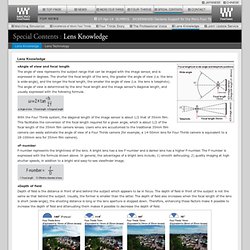
Image Courtesy: Juha Haataja. Digital Imaging: Glossary: Learn. Camera System: Glossary: Learn. Guides: Learn. Picasa Web Albums Features. Four Thirds. ●Angle of view and focal lengthThe angle of view represents the subject range that can be imaged with the image sensor, and is expressed in degrees.
Online magazine over digitale fotografie en meer. . . . Olympus - Cityscapes (1) Buying a digital SLR: Guides: Learn. Updated September 2013 Why buy a digital SLR? So you've decided to invest in a new digital camera and have made your mind up that you want to step up to a digital SLR, but the huge range of models on offer and endless flow of technical jargon have left you more confused than when you started? Carbon-Fiber Tripods - Outdoor Photographer. Gear Tuesday, June 1, 2004 By Zachary Singer For photographers who carry their gear long distances, saving weight is a real issue. We economize every way we can, leaving spare camera bodies behind or bringing fewer rolls of film. We carry lighter tripods, too, but until recently, there was a limit to how much weight we could save in our camera support.
Olympus Zuiko Digital 9-18mm 1:4-5.6 Lens Review: 1. Introduction. HDR ART Gallery. EXILIM Hi-Zoom EX-H20G Silver - EXILIM. Lasting memories with Hybrid GPS GPS conquers the camera world! Cursus Inschrijfformulier (Cursussen)