
Hint: It Ain't Twitter. (aka: An Open Letter to the Next Big Social Network. I've held off writing this post for a long time, because I couldn't quite get my head around all the issues.

It wouldn't be accurate to say there's something "wrong" with Facebook, and it's not like I don't spend a shitload of time ego-whoring around on Twitter too. Internet Founder Tim Berners-Lee Details 4 Concerns About Future of Mobile Web (Nokia World 2010) This morning at Nokia World 2010 in London, Sir Tim Berners-Lee, widely known as the inventor of the Web, addressed the audience in a keynote speech where he spoke about the future of mobile technology, including both the positive impacts it brings as well as the areas of concern.
After encouraging developers to build for the Web, so as to deliver applications that work on all types of devices, even the ones that haven't been invented yet, he then proceeded to detail areas which need addressing, specifically privacy, accountability, network neutrality and the 80% of the world that doesn't have access to the World Wide Web. The Mobile Web Today: Location is Just "Tip of the Iceberg" Berners-Lee began his keynote by discussing the improvements we've seen in technology in recent years, most notably the ability of our devices to be location-aware.
The 10 Founding Fathers of the Web. Web Services as Governments - Union Square Ventures: A New York. The State of the Internet Operating System. I’ve been talking for years about “the internet operating system“, but I realized I’ve never written an extended post to define what I think it is, where it is going, and the choices we face.
This is that missing post. Here you will see the underlying beliefs about the future that are guiding my publishing program as well as the rationale behind conferences I organize like the Web 2.0 Summit and Web 2.0 Expo, the Where 2.0 Conference, and even the Gov 2.0 Summit and Gov 2.0 Expo. Ask yourself for a moment, what is the operating system of a Google or Bing search?
What is the operating system of a mobile phone call? What is the operating system of maps and directions on your phone? On a standalone computer, operating systems like Windows, Mac OS X, and Linux manage the machine’s resources, making it possible for applications to focus on the job they do for the user. The War For the Web. On Friday, my latest tweet was automatically posted to my Facebook news feed, as always.
But this time, Tom Scoville noticed a difference: the link in the posting was no longer active. It turns out that a lot of other people had noticed this too. Mashable wrote about the problem on Saturday morning: Facebook Unlinks Your Twitter Links. if you’re posting web links (Bit.ly, TinyURL) to your Twitter feed and using the Twitter Facebook app to share those updates on Facebook too, none of those links are hyperlinked. Your friends will need to copy and paste the links into a browser to make them work.
As it turns out, it wasn’t just links imported from Twitter. The problem was quickly fixed, with URLs in status updates automatically now linkified again. Google CEO Eric Schmidt Interview: His Thoughts On Search, Books. A week ago I had a chance to sit down for a hour-long one on one interview with Google CEO Eric Schmidt.
Google CEO Eric Schmidt On The Future Of Search: “Connect It Str. This is Part 2 of my series of posts summarizing a fascinating recent hour-long one on one interview with Google CEO Eric Schmidt.
Early in the interview I asked Schmidt about the future of search. The Web At A New Crossroads. Guest post by Chris Messina and Jyri Engeström (thanks to Brynn Evans for editing and Brad Fitzpatrick for comments on the draft)…………………
$7.5 Million: Wikipedia Reaches Fundraising Goal. In what has become a Christmas tradition, Wikipedia founder Jimmy Wales posted a personal appeal for donations to the Wikimedia Foundation earlier this month.
On the first day alone, the nonprofit raised $430,000 from 13,000 people. Today, Wales announced that Wikimedia reached its fundraising goals. In total, the foundation managed to raise $7.5 million. Last year, when Wales posted a similar appeal, the Wikimedia Foundation received $6.2 million from 125,000 donors. Still No Ads Wikipedia and other Wikimedia properties like Wikiquote or Wikibooks could easily find enough advertisers to finance these sites. The Golden Triangle. A Big Week For The Mobile Web. When I use the word "mobile web", I am not referring to the web running in mobile browsers, although I understand that is what the words have come to mean.
I believe that mobile devices are bringing web services into our pockets and purses, onto restaurant tables and bars, and into schools and stadiums. I am not particularly concerned about whether these web services are deployed in a browser or in an app running on a mobile device. I realize that these are big issues for developers and that the mobile web suffers from too many browsers, too many operating systems, and too many device configurations and screen sizes.
Mark Pincus: Web 3 Is The App Economy. Today at the Web 2.0 Summit in San Francisco, Zynga CEO Mark Pincus took the stage to talk about social gaming.
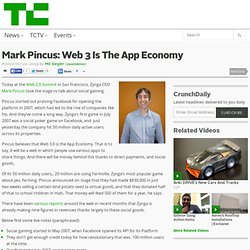
Pincus started out praising Facebook for opening the platform in 2007, which had led to the rise of companies like his. And they’ve come a long way. Zynga’s first game in July 2007 was a social poker game on Facebook, and just yesterday the company hit 50 million daily active users across its properties. Pincus believes that Web 3.0 is the App Economy. That is to say, it will be a web in which people use various apps to share things. Of its 50 million daily users,, 20 million are using Farmville, Zynga’s most popular game about yes, farming. There have been various reports around the web in recent months that Zynga is already making nine figures in revenues thanks largely to these social goods. Below find some live notes (paraphrased) My world has changed (and I get to share with you)
Twitter’s new list feature is one of those things that seems simple on the surface and is easily ignored. But it has deeply changed how I get my news and how I interact with the tech community. Click through these lists and you’ll see a different world than you would have thought possible on Twitter. This is the order I visit the lists in the morning: Tech News Brands. Here’s 500 tech news sources.
Six Social Media Trends for 2010 - Conversation Starter - Harvar. By David Armano | 9:54 AM November 2, 2009 In 2009 we saw exponential growth of social media. According to Nielsen Online, Twitter alone grew 1,382% year-over-year in February, registering a total of just more than 7 million unique visitors in the US for the month.
Meanwhile, Facebook continued to outpace MySpace. The Age of Mega Content Sites - Answers.com and Demand Media. Two companies that produce massive quantities of new content every day, Answers.com and Demand Media, are rapidly moving up the list of top U.S. web properties, as measured by comScore. Answers.com has risen from #26 to #13 in just two months, and Demand Media has risen from #24 to #15 in the same time period.
The Internet Won't Keep Us From Returning To The Dark Ages, Says. Mary Meeker: Mobile Internet Will Soon Overtake Fixed Internet. Mary Meeker of Morgan Stanley isn’t just any Internet analyst. She was covering the sector when the brokerage firm was the lead underwriter for Netscape Communications’ initial public offering in 1995, was dubbed the “Queen of the Net” by Barron’s magazine in 1998 and was covering the space in 2004, when Morgan Stanley helped launch the Google IPO.