
Interactive 3D model of Solar System Planets and Night Sky - StumbleUpon. Astronomy For Beginners...Astronomy Basics...Amazing Astronomy Facts. Supernova. A supernova (abbreviated SN, plural SNe after "supernovae") is a stellar explosion that is more energetic than a nova.
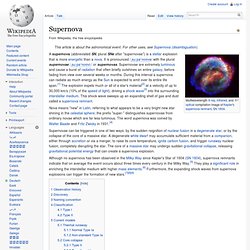
It is pronounced /ˌsuːpəˈnoʊvə/ with the plural supernovae /ˌsuːpəˈnoʊviː/ or supernovas. Supernovae are extremely luminous and cause a burst of radiation that often briefly outshines an entire galaxy, before fading from view over several weeks or months. During this interval a supernova can radiate as much energy as the Sun is expected to emit over its entire life span.[1] The explosion expels much or all of a star's material[2] at a velocity of up to 30,000 km/s (10% of the speed of light), driving a shock wave[3] into the surrounding interstellar medium.
Interstellar medium. In astronomy, the interstellar medium (or ISM) is the matter that exists in the space between the star systems in a galaxy.
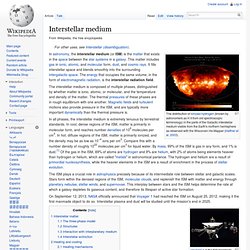
This matter includes gas in ionic, atomic, and molecular form, dust, and cosmic rays. It fills interstellar space and blends smoothly into the surrounding intergalactic space.