
SOLO Taxonomy Network. New Tab. Shornymorgan: #SOLO with hexagons at #TLT13... KS3 Science Cell Division using SOLO taxonomy. Willmaths: Finally decided I should join. Willmaths: @kimberlyannmac @arti_choke... A Geography Lesson: Making the learning visible. I remember being new to teaching and asking students to do complex thinking (analyse this….
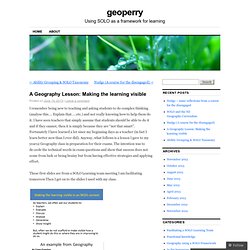
Explain that…..etc.) and not really knowing how to help them do it. I have seen teachers that simply assume that students should be able to do it and if they cannot, then it is simply because they are “not that smart”. Fortunately I have learned a lot since my beginning days as a teacher (in fact I learn better now than I ever did). Anyway, what follows is a lesson I gave to my year12 Geography class in preparation for their exams. The intention was to de-code the technical words in exam questions and show that success does not come from luck or being brainy but from having effective strategies and applying effort. Solo Taxonomy & The Art of Passing Exams. @natkin I will start with a confession.

I was far from being a model student , but I never failed any test. Teachesliteracy: My generic #SOLOTaxonomy... SOLO Stations. SOLO Stations. From HookED Wiki Alternative names: SOLO carousel, SOLO bus stop, SOLO circus, SOLO Pick and Mix.

In this approach teachers set up “stations” featuring differing learning activities in the classroom or another location. Each SOLO station features a learning activity suitable for students with, prestructural, unistructural, multistructural, relational, and extended abstract understanding of the text. Small groups of students rotate through the different SOLO differentiated stations and activities throughout the lesson. SOLO differentiated success criteria are available at each station and self and peer assessment is encouraged throughout. In some cases teachers use virtual stations - SOLO differentiated worksheets of activities and tasks - where students choose the “station” they will be working on - and no physical movement is required. Philips High School. Introduction to Solo Taxonomy by Mr McHugh on Prezi. How to introduce SOLO Taxonomy. Introducing a school community to SOLO Taxonomy (Biggs and Collis 1982) is a little like squeezing yourself into a Captain Kirk onesie and imagining yourself standing on the deck of the Enterprise.

“Space, the final frontier. These are the voyages of the starship Enterprise. Its five year mission: to explore strange new worlds; to seek out life and new civilizations; to boldly go where no man has gone before.” Captain Kirk of “Star Trek” You have to introduce a complex idea in a few sentences – the experience must be simple enough to be remembered and yet quirky enough to capture people’s attention. Going SOLO: An introduction to the taxonomy everyone’s talking about. This article originally appeared in Innovate My School's September 2012 digital magazine.
The Structure of Observed Learning Outcome (SOLO) taxonomy aims to show pupils how to develop sophisticated responses to questions by getting them to examine their thought-process as their understanding of a topic improves. I began using SOLO in 2011, and it is now integral to my teaching. SOLO defines five stages of understanding for any topic: prestructural, unistructural, multistructural, relational and extended abstract. The first three involve gathering relevant information.
The other two are about using that information: linking facts and findings, questioning existing ideas about the topic, and forming new theories. All well and good. SOLO LEVEL: PRESTRUCTURAL (the pupil has missed the point) Post-it hexagons. Mr_Betts: AS/A2 Independent Learning... SimBadd64: My newly completed Accelerated... Learner Evolution ~ Chris Harte: Brains on the SOLO table. So here starteth the mystery...

Tait Coles and I were conversing about the SOLO taxonomy on twitter when I sent him an article by David Leat and Adam Nichols on the use of mysteries to concretely demonstrate learner understanding. Now Tait and I both have a passion for student learning and an equal passion for our own learning so the possibility of collaborating on a blog post was too great to miss out. Small problem; I live in Melbourne, Australia and Tait lives in Bradford, England. 10,000 miles apart, a 10 hour time difference, what a pickle. Luckily, being resilient and resourceful learners, we put a collaborative Google Drive folder together and started writing together. So welcome to the fruits of our labour, well at least the first part... Using SOLO as a framework for learning. SOLO Apps. SOLO 5 min lesson plan.pdf. EmmaWatts - Starting SOLO. SOLO Taxonomy by Tait Coles on Prezi. @kennypieper #solo. The Light That Falls Through the Cracks - Solo Stations in English. For some time now I’ve been working with Solo Taxonomy and enjoying the ways that pupils are able to be in charge of their own learning and progress.

Another added advantage is that they are able to articulate that progress to any observer… all key ingredients of an Outstanding lesson. We’ve just reached the end of our first unit in GCSE English, non-fiction, and I wanted to recap on what we’d learned but without doing a dull revision lesson. So taking a leaf out of several other Solo Taxonomists’ books, I decided to try a derivative of Solo Stations for the first time. I was particularly keen that the pupils reviewed their knowledge of persuasive techniques, language features and presentational devices so for the stimulus material I downloaded several property brochures from www.rightmove.co.uk (I went for high-end property in West Sussex as that had some great examples of the hyperbole of Estate Agents with some pretty pictures!)
Solo taxonomy cognitive workout by HookED Educational Consultancy. Arti_choke: @Gripweed1 SOLO in programming... Is SOLO a waste of time? Stop blaming your lack of experimentation, risk and innovation on your lack of time.Hywel Roberts – Oops!

Helping Children Learn Accidentally It was pointed out to me recently that I can afford to expend my energies on such fripperies as the SOLO taxonomy and group work because I teach a subject which is rich in curriculum time. If, the logic goes, you only have 1 or 2 hours per week you need to spend it delivering content. Anything else is a waste of time. Clearly there’s some truth in this: English does get more time than, say, French or RE. Purple Elf's Learning Adventures. Wilmslow High School's 'Lookout for Learning'
The Structure of Observed Learning Outcome (SOLO) taxonomy is a model of learning that: “Provides a simple and robust way of describing how learning outcomes grow in complexity from surface to deep understanding” Biggs and Collin (1982)Is similar to Bloom’s taxonomy but it has one major advantage: SOLO taxonomy provides a user friendly, common language of learning that enables the student and teacher to explicitly understand the learning process.

The 5 levels of understanding are: Pre-structural – The task is not attacked appropriately; the student hasn’t really understood the point and uses too simple a way of going about it.Uni-structural – The student’s response only focuses on one relevant aspect.Multi-structural – The student’s response focuses on several relevant aspects but they are treated independently and additively. Assessment of this level is primarily quantitative.Relational – The different aspects have become integrated into a coherent whole. 1. 2. 3. 4. 5. 6. 7. @Westylish's Blog: Making My Solo Taxonomy Debut. Two weeks ago I started to use solo taxonomy for the first time.

I had read several posts about the taxonomy on Twitter and felt it could work well with GCSE history source analysis. I liked the way that students could build up their answers working through the different levels of the mark scheme. Below is a video blog recording my thoughts: Since making this video I have been observed using solo taxonomy in this way and the following aspects of solo taxonomy contributed to a successful lesson in that instance.By its nature it is student led.
All of the students in my class were engaged and active in their learning.It allowed for some natural differentiation as students worked at their own pace. Going SOLO: An introduction to the taxonomy everyone’s talking about. Going SOLO for the First Time …… After following the correspondence on Twitter between the likes of @JohnSayers, @EmmaAbuDabi, @aknill and others, I became interested in the idea of using SOLO taxonomy in my Geography lessons. So, as I began the process of planning my lessons for the second half of the Autumn Term, I decided to take the plunge and give it a try with a year nine group who were about to embark on a unit of work on earthquakes. SOLO Hexagon Generator. This HookED app populates a SOLO Hexagon Template. Brainstorm content ideas and enter them in the fields below. Click “Generate Document” to populate the template. Print the template and cut out the hexagons. Ask students to arrange the hexagons in sequences and clusters, justifying and annotating any connections made.
Unistructural learning outcome-student identifies one hexagonMultistructural learning outcome-student identifies several hexagonsRelational learning outcome-student connects hexagons and explains the connections with annotations.Extended abstract learning outcome– student tessellates (clusters) hexagons adding annotations to make generalisations about a vertex (intersection point). SOLO taxonomy « David Didau: The Learning Spy. A few weeks ago I rather rashly offered to present on SOLO taxonomy to the North Somerset Aspire network. As always with this sort of foolishness it’s made me consider my understanding of the subject in a lot more depth. Before the Summer I’d never even heard of it.