
Renaissance humanism. Humanism is the resurgent study of classical antiquity, at first in Italy, and then spreading across Western Europe in the 14th, 15th and 16th centuries.
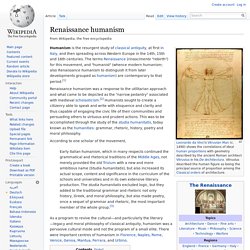
The terms Renaissance (rinascimento "rebirth") for this movement, and "humanist" (whence modern humanism; also Renaissance humanism to distinguish it from later developments grouped as humanism) are contemporary to that period.[1] Renaissance humanism was a response to the utilitarian approach and what came to be depicted as the "narrow pedantry" associated with medieval scholasticism.[2] Humanists sought to create a citizenry able to speak and write with eloquence and clarity and thus capable of engaging the civic life of their communities and persuading others to virtuous and prudent actions. This was to be accomplished through the study of the studia humanitatis, today known as the humanities: grammar, rhetoric, history, poetry and moral philosophy. According to one scholar of the movement,
Humanisme de la Renaissance. Un article de Wikipédia, l'encyclopédie libre.
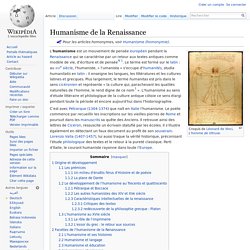
L'humanisme est un mouvement de pensée européen pendant la Renaissance qui se caractérise par un retour aux textes antiques comme modèle de vie, d'écriture et de pensée[N 1]. Le terme est formé sur le latin : au XVIe siècle, l'humaniste, « l'umanista » s'occupe d'humanités, studia humanitatis en latin : il enseigne les langues, les littératures et les cultures latines et grecques. Plus largement, le terme humanitas est pris dans le sens cicéronien et représente « la culture qui, parachevant les qualités naturelles de l'homme, le rend digne de ce nom[1] ».
L'humanisme au sens d'étude littéraire et philologique de la culture antique côtoie ce sens élargi pendant toute la période et encore aujourd'hui dans l'historiographie. C’est avec Pétrarque (1304-1374) que naît en Italie l'humanisme. Origine et développement[modifier | modifier le code] Les prémices[modifier | modifier le code] Renaissance-Humanismus. Renaissance-Humanismus [ʀənɛˈsɑ̃s] ist die moderne Bezeichnung für eine machtvolle geistige Strömung in der Zeit der Renaissance, die zuerst von Francesco Petrarca (1304–1374) angeregt wurde, in Florenz ein herausragendes Zentrum hatte und sich im 15. und 16.

Jahrhundert über den größten Teil Europas ausbreitete. In erster Linie war es eine literarisch ausgerichtete Bildungsbewegung. Die Humanisten traten für eine umfassende Bildungsreform ein, von der sie eine optimale Entfaltung der menschlichen Fähigkeiten durch die Verbindung von Wissen und Tugend erhofften. Humanistische Bildung sollte den Menschen befähigen, seine wahre Bestimmung zu erkennen und durch Nachahmung klassischer Vorbilder ein ideales Menschentum zu verwirklichen. Ein wertvoller, wahrheitsgemäßer Inhalt und eine vollendete sprachliche Form bildeten für die Humanisten eine Einheit. Begriffsgeschichte[Bearbeiten] Das Wort „Humanist“ ist erstmals gegen Ende des 15. Jacob Burckhardt. Carl Jacob Christoph Burckhardt (May 25, 1818 – August 8, 1897) was a historian of art and culture, and an influential figure in the historiography of each field.

He is known as one of the major progenitors of cultural history.[1] Siegfried Giedion described Burckhardt's achievement in the following terms: "The great discoverer of the age of the Renaissance, he first showed how a period should be treated in its entirety, with regard not only for its painting, sculpture and architecture, but for the social institutions of its daily life as well. "[2] Burckhardt's best known work is The Civilization of the Renaissance in Italy (1860). Life[edit] The son of a Protestant clergyman, Burckhardt was born and died in Basel, where he studied theology in the hope of taking holy orders; however, under the influence of De Wette he chose not to become a clergyman.
See Life by Hans Trog in the Basler Jahrbuch for 1898, pp. 1–172. Burckhardt is currently featured on the Swiss thousand franc banknote. Jacob Burckhardt. Jacob Burckhardt, nach 1890 Jacob Christoph Burckhardt (* 25.

Mai 1818 in Basel; † 8. August 1897 ebenda) war ein Schweizer Kulturhistoriker mit Schwerpunkt Kunstgeschichte. Burckhardt Jacob. Giovanni Pico della Mirandola. 1.

Life Pico was born on February 24, 1463, to a noble Italian family, the counts of Mirandola and Concordia near Modena in the Emilia-Romagna north of Tuscany. At the age of fourteen he left for Bologna, intending briefly to study canon law, but within two years he moved to Ferrara and shortly afterward to Padua, where he met one of his most important teachers, Elia del Medigo, a Jew and an Averroist Aristotelian. By the time he left Padua in 1482, he had also felt the attraction of the Platonism being revived by Marsilio Ficino, and by 1484 he was corresponding with Angelo Poliziano and Lorenzo de'Medici about poetry. In 1485 he traveled from Florence to Paris, the citadel of Aristotelian scholasticism. After a short stay in Paris, Pico returned to Florence, and then Arezzo, where he caused a scandal by abducting a young woman named Margherita, already married to Giuliano Mariotto de'Medici. Intervention by the Holy See derailed Pico's plans and blocked the conference. 2.
Giovanni Pico della Mirandola. Lorenzo Valla.